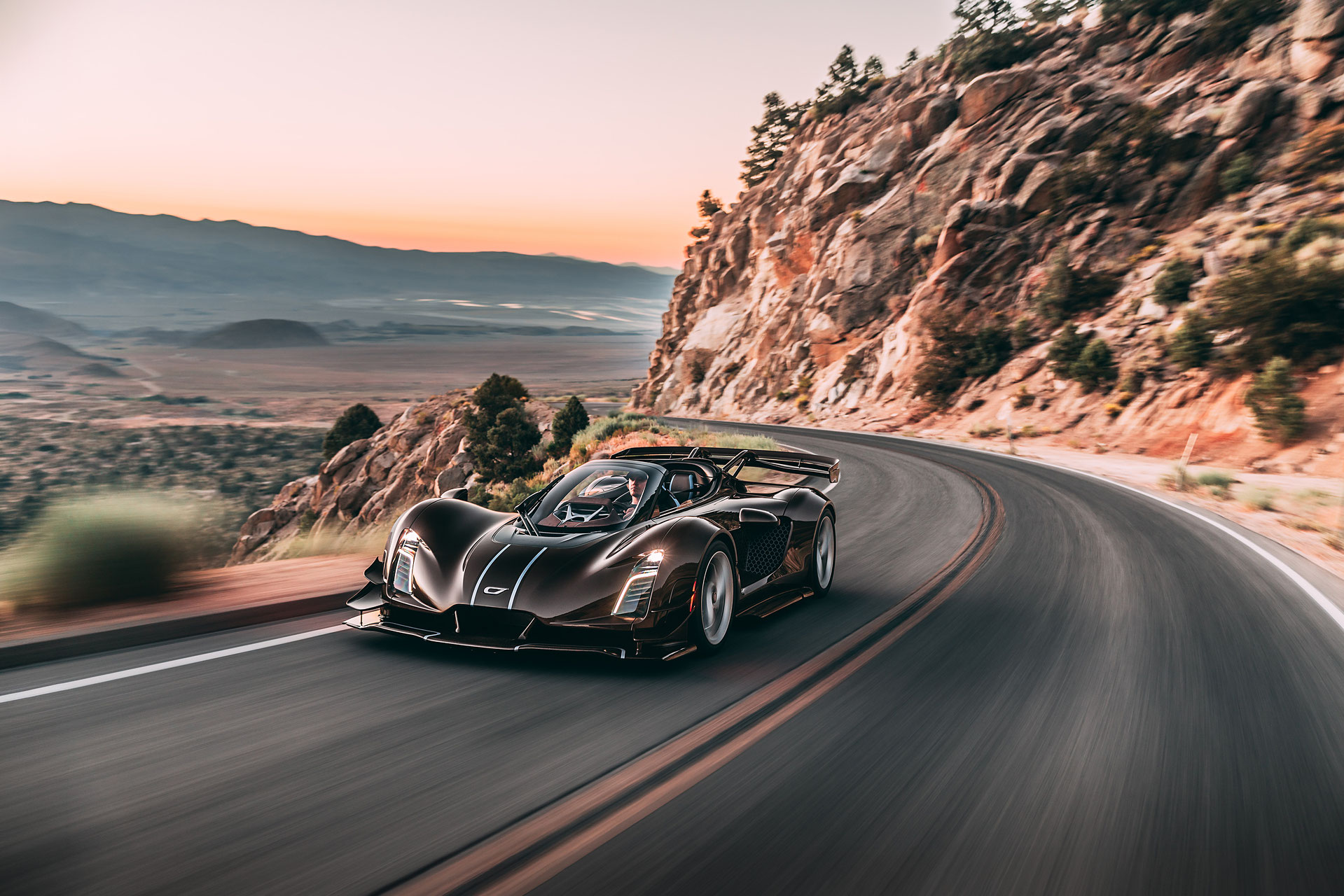
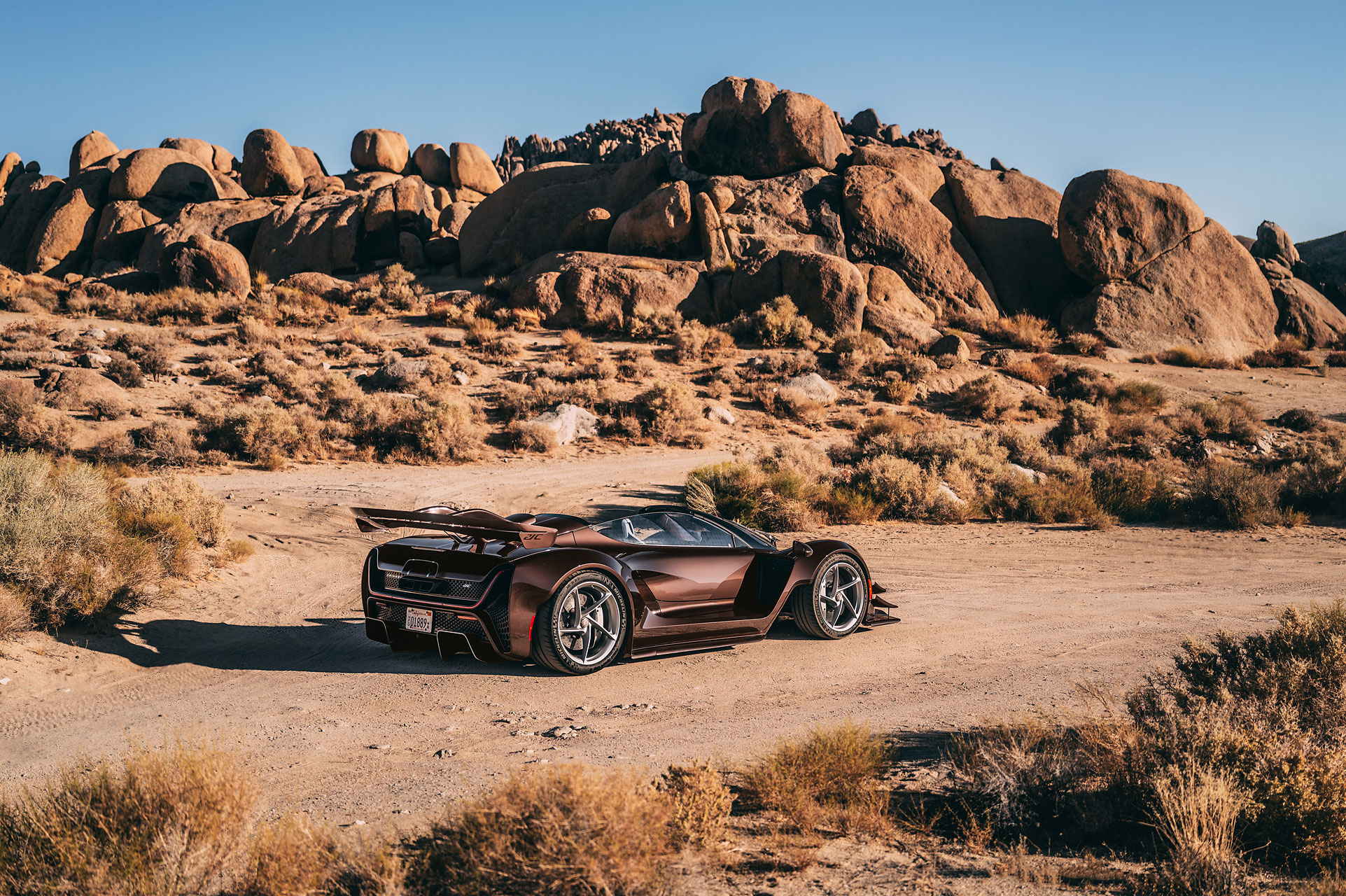
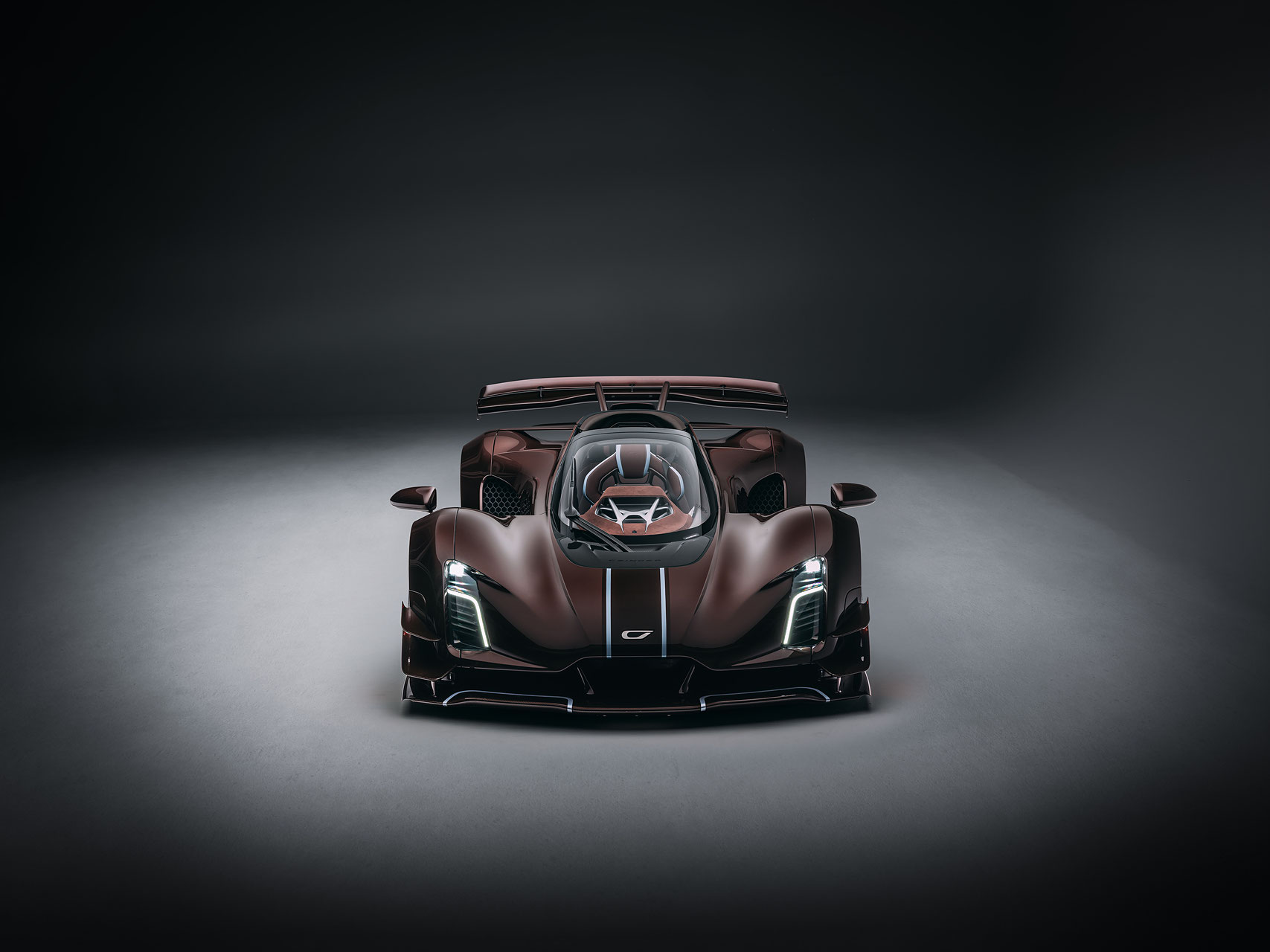
Czinger has revealed the 21C Spyder during Monterey Car Week, the first open-top version of its 21C hypercar and the third variant of the platform alongside the 21C HDF and 21C VMax. Production is limited to 30 examples, each hand-assembled at the company’s Area 21 facility in Los Angeles, with pricing starting at $2.75 million. The car is fully homologated for road use, including all 50 U.S. states.
Power comes from Czinger’s in-house 2.88-liter twin-turbocharged flat-plane V8, which produces 750 hp and 396 lb-ft on 91-octane fuel and revs to 11,000 rpm. Czinger claims that makes it the most power-dense homologated V8 in production at 260 hp per liter, with the engine weighing 231 pounds (105 kg). Two permanent-magnet synchronous motors drive the front wheels independently, and a third motor acting as a Motor Generator Unit is connected to the crankshaft, primarily charging a pair of 2.1 kWh 800-volt batteries while also helping spin the crank to reduce turbo lag. The motors add 500 hp for a combined 1,250 hp and 691 lb-ft. Czinger quotes 0 to 60 mph in 1.9 seconds, a quarter mile in 8.7 seconds, and a top speed of 205 mph with the roof in place. Combustion power runs through a seven-speed sequential automated manual co-developed with Xtrac, using 48-volt electric shift actuation and controlled by three electric motors, one managing the clutch while the others operate the twin selector barrels for sub-100-millisecond shifts.
The Spyder debuts BrakeNode, which Czinger describes as the first fully integrated, topology-optimized, additively manufactured brake assembly. Built from the company’s proprietary Z301 aluminum alloy, it consolidates the brake caliper, suspension upright, and hydraulic fluid passages into a single structure, with the fluid passage threading through the component rather than running as an external line. Czinger says the design reduces unsprung mass and increases stiffness by up to 30 percent each against conventional brake structures, and cuts total unsprung mass by a further 6 pounds (2.7 kg) over the outgoing additively manufactured upright, or 1.5 pounds per corner. Reinforced hollow structures make up as much as 37 percent of the assembly. Stopping distance is reduced by up to 15 percent, according to the company, which also states the unit has been tested to roughly 7,250 psi (500 bar), around eight times the 21C’s normal operating pressure.
BrakeNode clamps carbon ceramic rotors measuring 16.1 inches (410 mm) at the front and 15.3 inches (390 mm) at the rear, with six-piston monoblock calipers up front and four-piston units at the rear. Front calipers use titanium pistons, which Czinger says keep hydraulic fluid 15 percent cooler than stainless steel pistons, while the rear calipers use aluminum pistons to save weight. Pads can be removed through the top of the structure and rotors tilted out from the side without disconnecting the caliper. BrakeNode is standard on the Spyder and available as an upgrade on both new and previously delivered 21C HDF and 21C VMax cars.
Inside, NeuralNode replaces the multi-part structure of a conventional dashboard with a single integrated system that encases the instrument panel and carries forward-facing air vents fed through hollow channels within the structure itself. Two arms extend from either side toward a redesigned additively manufactured steering wheel, mounting machined metal lighting, drive mode, and climate controls. The cabin adds additively manufactured phone and key mounts and a cupholder. The driver display doubles as the infotainment system with wireless Apple CarPlay, and audio runs through a 650-watt Morel system with eight speakers and carbon fiber cones.
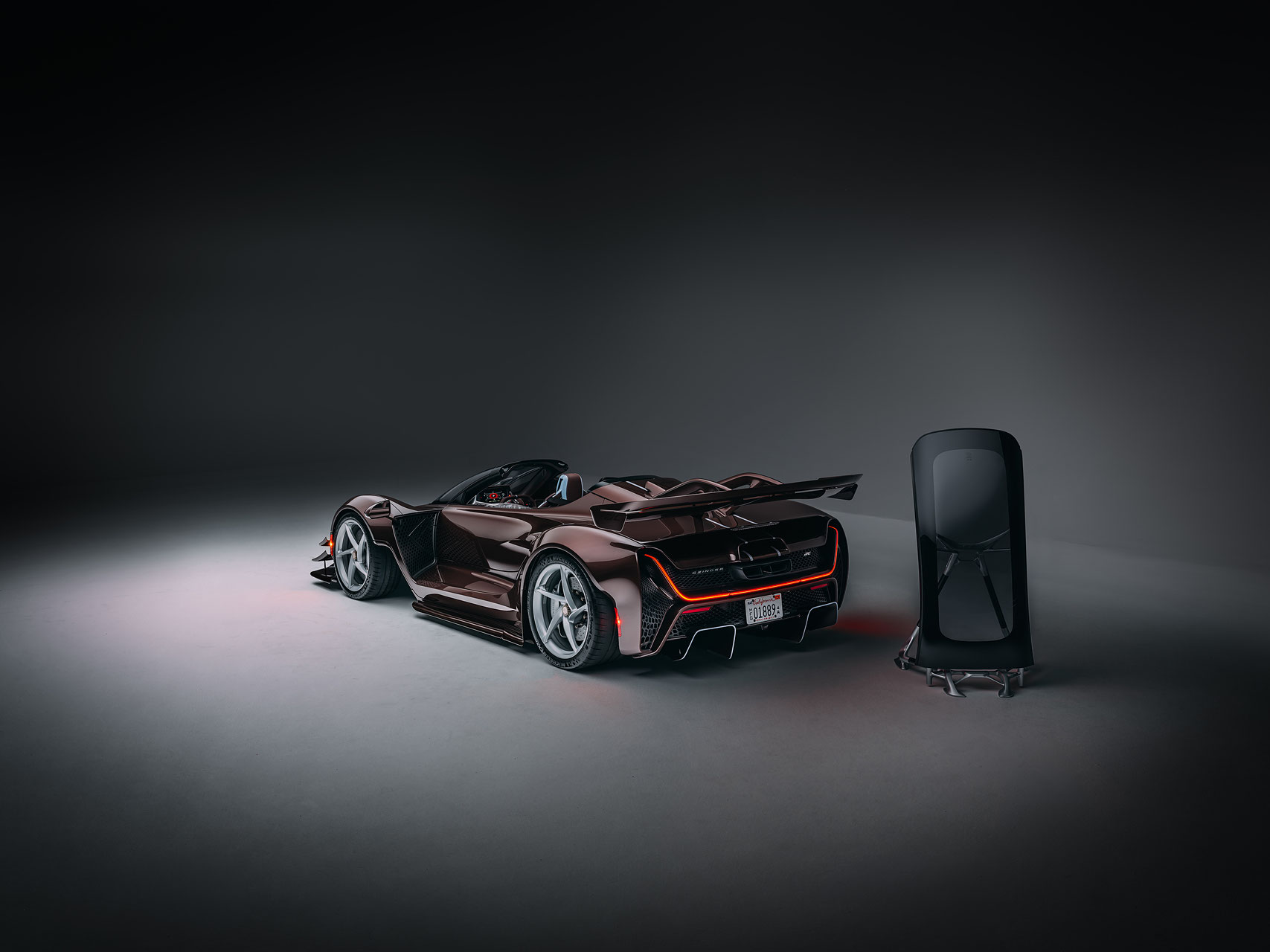
The removable carbon fiber hardtop weighs 22 pounds and detaches via two latches inside the cabin, stored afterward on a dedicated BioLogic Roof Mount included with the car. A stowable soft top is also supplied for unexpected weather. The Spyder retains the central in-line seating layout, with the rear seat accommodating passengers up to 6 feet 5 inches, and adds carbon fiber piling in the A-pillars for rollover safety. Dry weight is 3,571 pounds (1,620 kg), 22 pounds more than the 21C HDF.
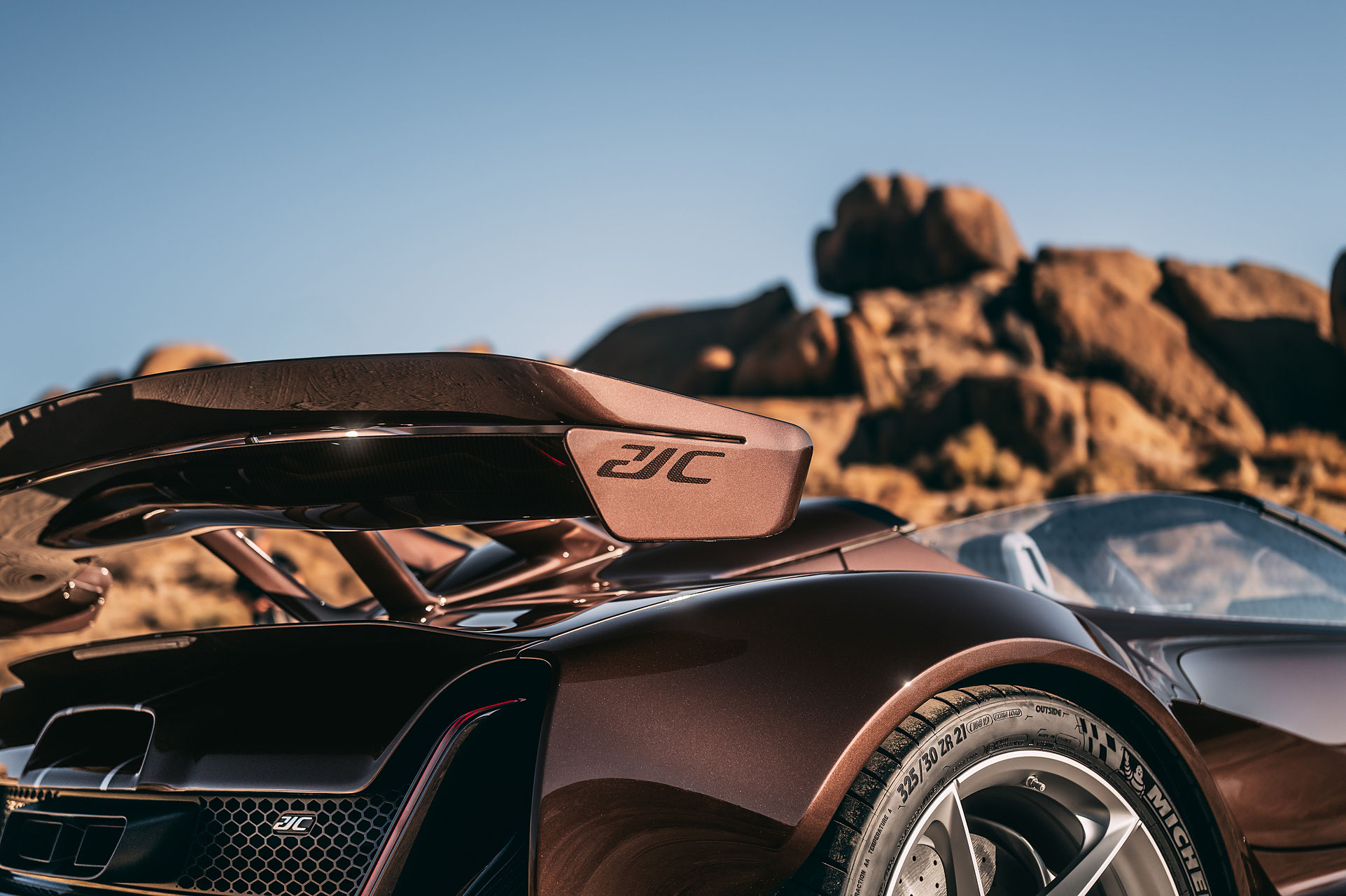
At 150 mph with the roof removed, the Spyder generates 3,267 pounds (1,482 kg) of downforce, which Czinger says is the most of any open-top road car. With the roof fitted, that rises to 3,307 pounds (1,500 kg), matching the 21C HDF, and the company quotes a maximum of 5,445 pounds (2,470 kg) at 200 mph with the roof closed. Roughly 57 percent of the load is biased rearward. The aero package includes an extended front splitter working in ground effect, twin dive planes, full-length channeled side splitters, a multi-channel full-length diffuser, and a dual-element 76-inch rear wing with swan-neck uprights and a three-way adjustable assembly. Czinger quotes a lift-to-drag ratio of 3.0:1.
Czinger states that 23 percent of the 21C Spyder is additively manufactured using processes developed by sister company Divergent Technologies. Suspension is a double A-arm pushrod layout with inboard spring and damper units and electronically adjustable damping, with additively manufactured control arms the company says are 20 percent lighter than conventional pieces and shaped to cut drag by 10 percent. A three-piece Z-bar replaces a conventional front sway bar. The car rides on Michelin Pilot Sport Cup 2, Cup 2R, or Pilot Sport 4S tires in 265/35R20 front and 325/30R21 rear.
Four drive modes are offered, with Street running the front electric motors alone below 60 mph before the rear axle engages and total output rises to 1,140 hp. Sport keeps the combustion engine running at all speeds with the same 1,140 hp, Track unlocks the full 1,250 hp and holds gears to the 11,000 rpm redline from second upward, and Track+ drops ride height by about 1 inch (25 mm) and stiffens the dampers by 50 percent for circuit use. Czinger says the 21C underwent more than 35 crash tests during development, with additional roof crush testing conducted for the Spyder.
GalleryPhotos by Czinger