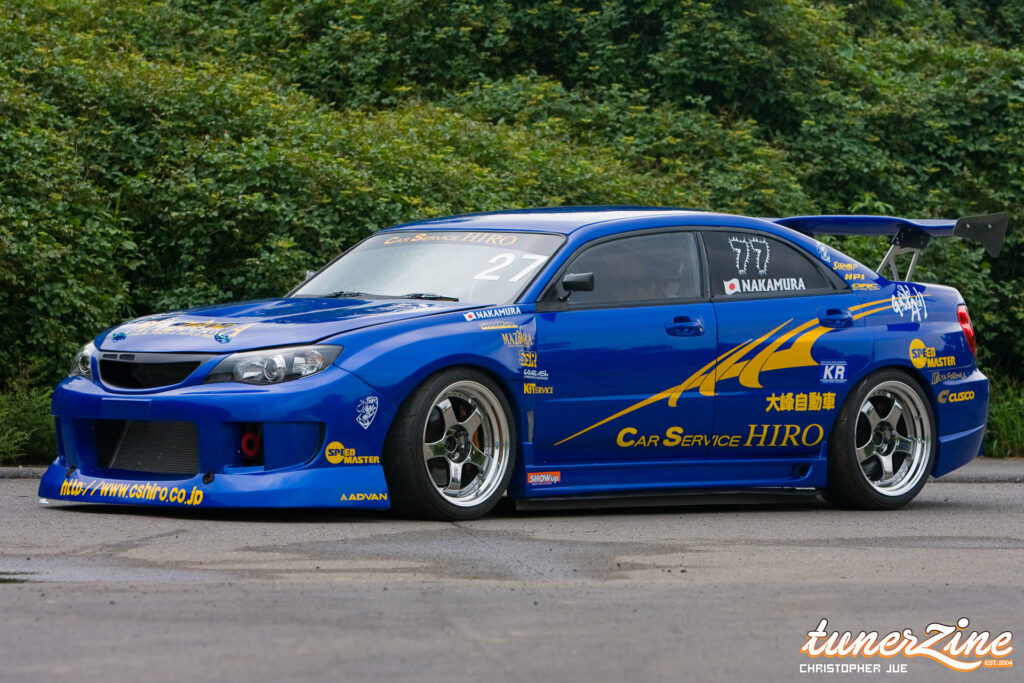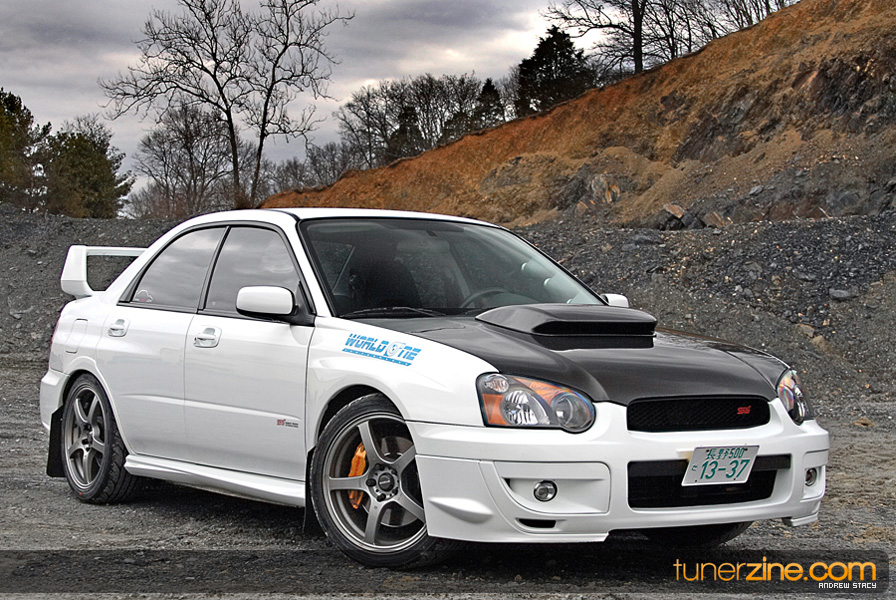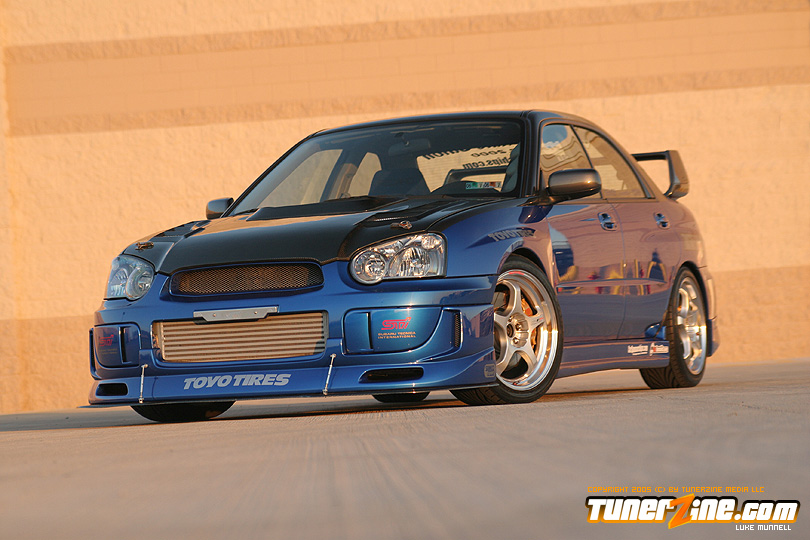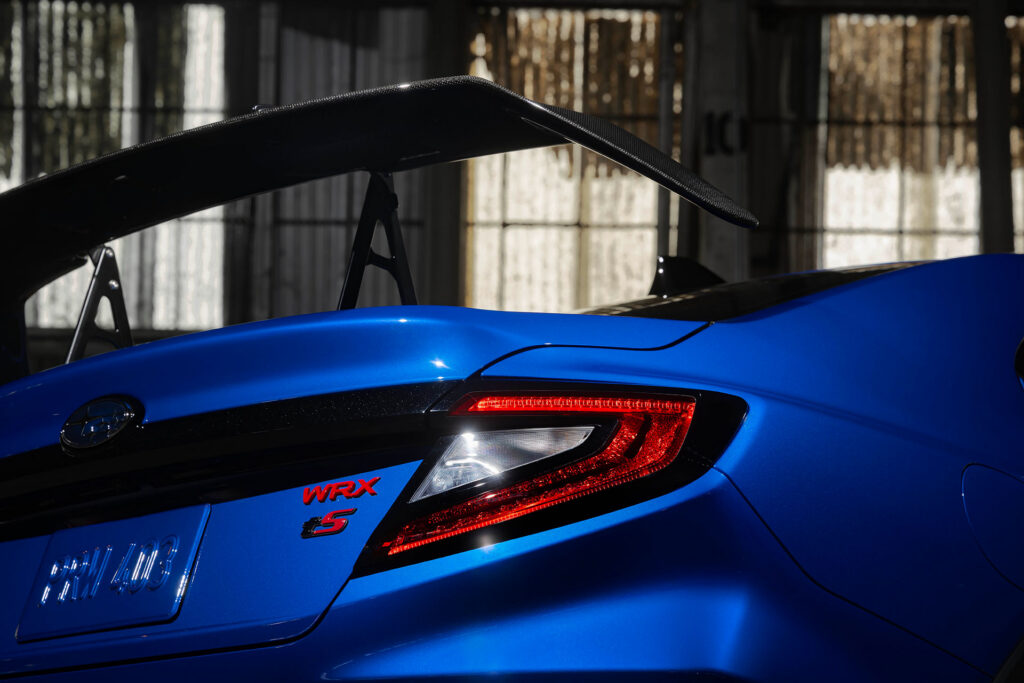
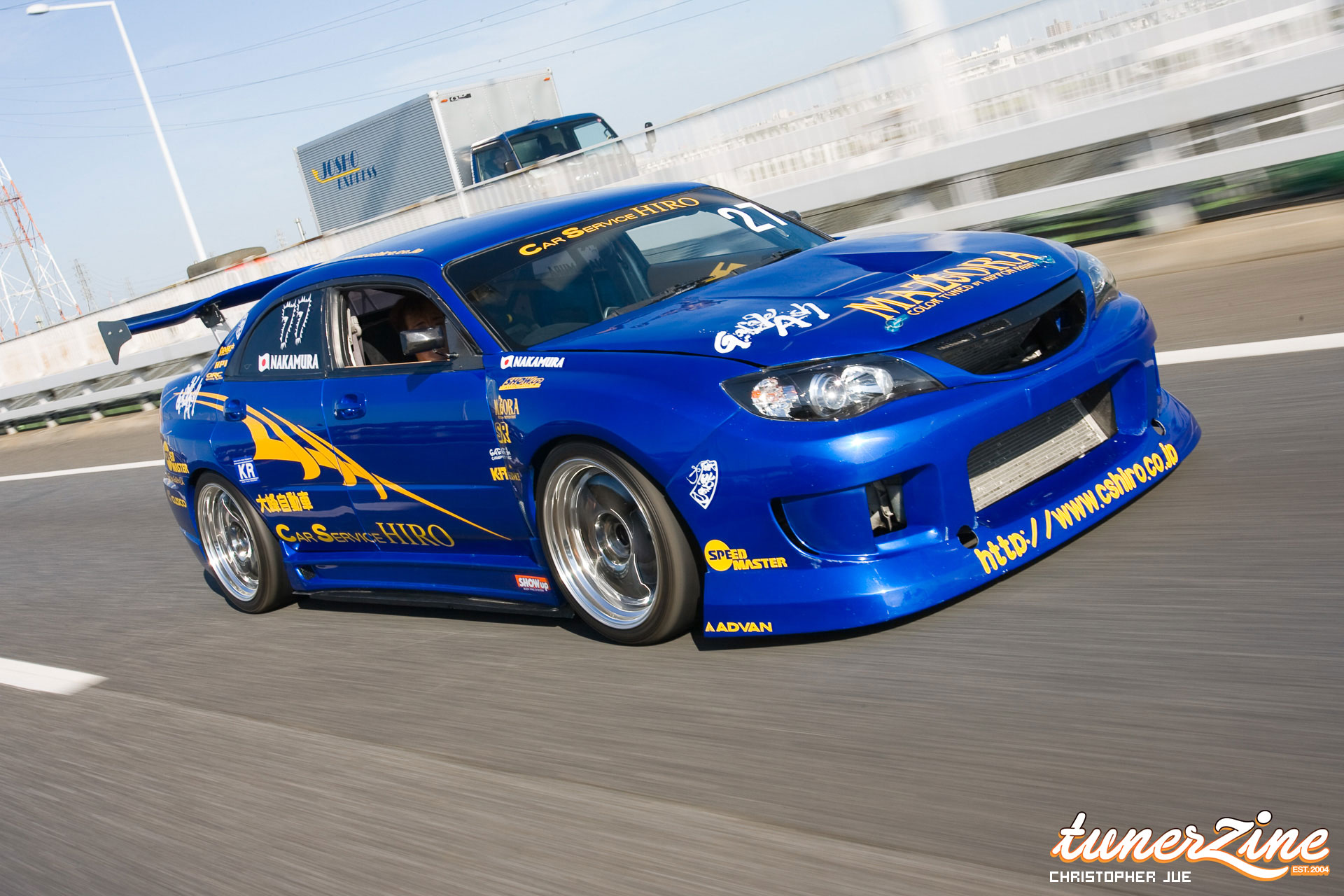
Most show cars follow the same life cycle. A shop builds one to draw a crowd, it does a season or two of duty under the lights, and then it either gets parted out or quietly disappears into a warehouse. The GDB you are looking at took a stranger route. When the GD-chassis Impreza arrived in 2000, Subaru itself approached Takahiro Nakamura of Car Service Hiro and asked him to take a stock GDB and turn it into an all-out show car. Nakamura did exactly that. Then, once the car had served its purpose, Subaru decided to sell it, and the man who built it bought it back. There are plenty of builders who would love to own the car they poured themselves into for someone else. Nakamura actually got to.
With the car in his own hands, the build kept evolving, and you can see it right on the original Japanese spec sheet we dug up for this one. The printed specs list Work wheels in 17×9 and 255-series Advans; the handwritten revisions in red pen bump the car to SSR 18x10s at all four corners wrapped in 265/35R18 Yokohama Advan A048s, and the Swift spring rates climb from 18 kg/mm front and 14 kg/mm rear to a properly stiff 22 kg/mm and 16 kg/mm. A show car that gets its spring rates revised upward means it’s no longer a show car, but one that’s being driven. The evolution didn’t stop at the spec sheet either. The car you see in these photos wears the later hawkeye front end, a face that didn’t exist when Subaru first handed Nakamura the keys, so even the car’s identity has been updated over its life.
Under the hood, the EJ25 was built with function in mind rather than dress-up. The 2.5-liter flat-four runs Manley forged pistons in a 99.5mm bore with a molybdenum coating, WPC-treated connecting rods and crankshaft, JUN high cams with 272 degrees of duration on both sides, and a 1.0mm metal head gasket dropping compression to 8.5:1. Boost comes from an AVO turbo kit breathing through an HKS Super Power Flow intake and a Prova exhaust manifold, with an ARC intercooler and a Trust 15-row oil cooler keeping temperatures in check alongside a one-off radiator. Fueling runs 800cc injectors and a Bosch pump, a Blitz boost controller holds 24 psi (1.7 kg/cm2), and the whole thing answers to a MoTeC engine management system with a MoTeC dash logger inside. The catalyzer and muffler are Hiro’s own pieces.
The driveline keeps the stock six-speed but backs it with an ORC twin-plate clutch and Cusco RS limited-slip differentials at both ends. Suspension is Koni adjustable dampers over those Swift springs, with Cusco full pillow-ball arms up front and Ikeya Formula full pillow-ball hardware in the rear. Braking stays on the factory four-pot front and two-pot rear calipers with PFC pads, which tells you Nakamura saw no reason to fix what the STI already did well.
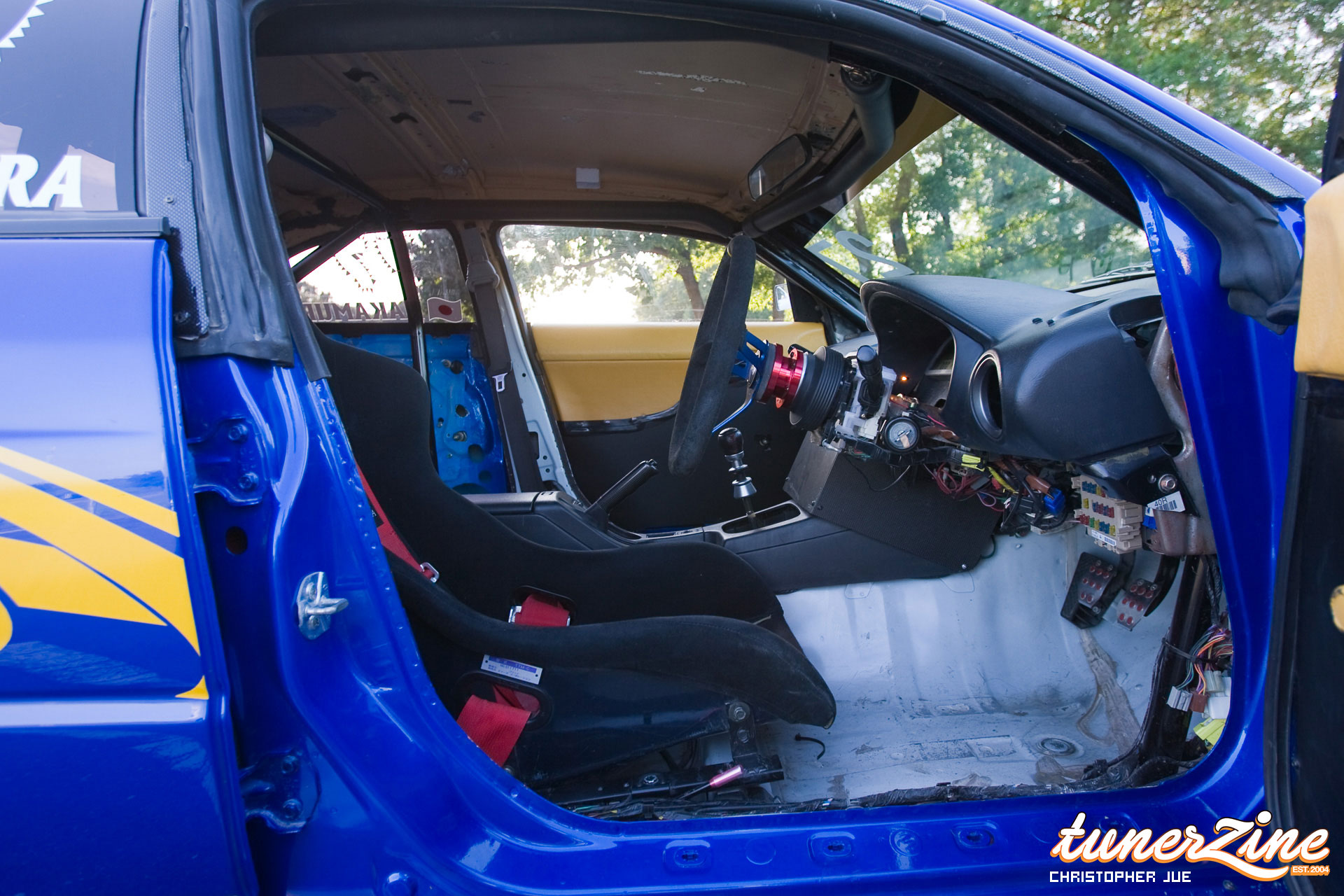
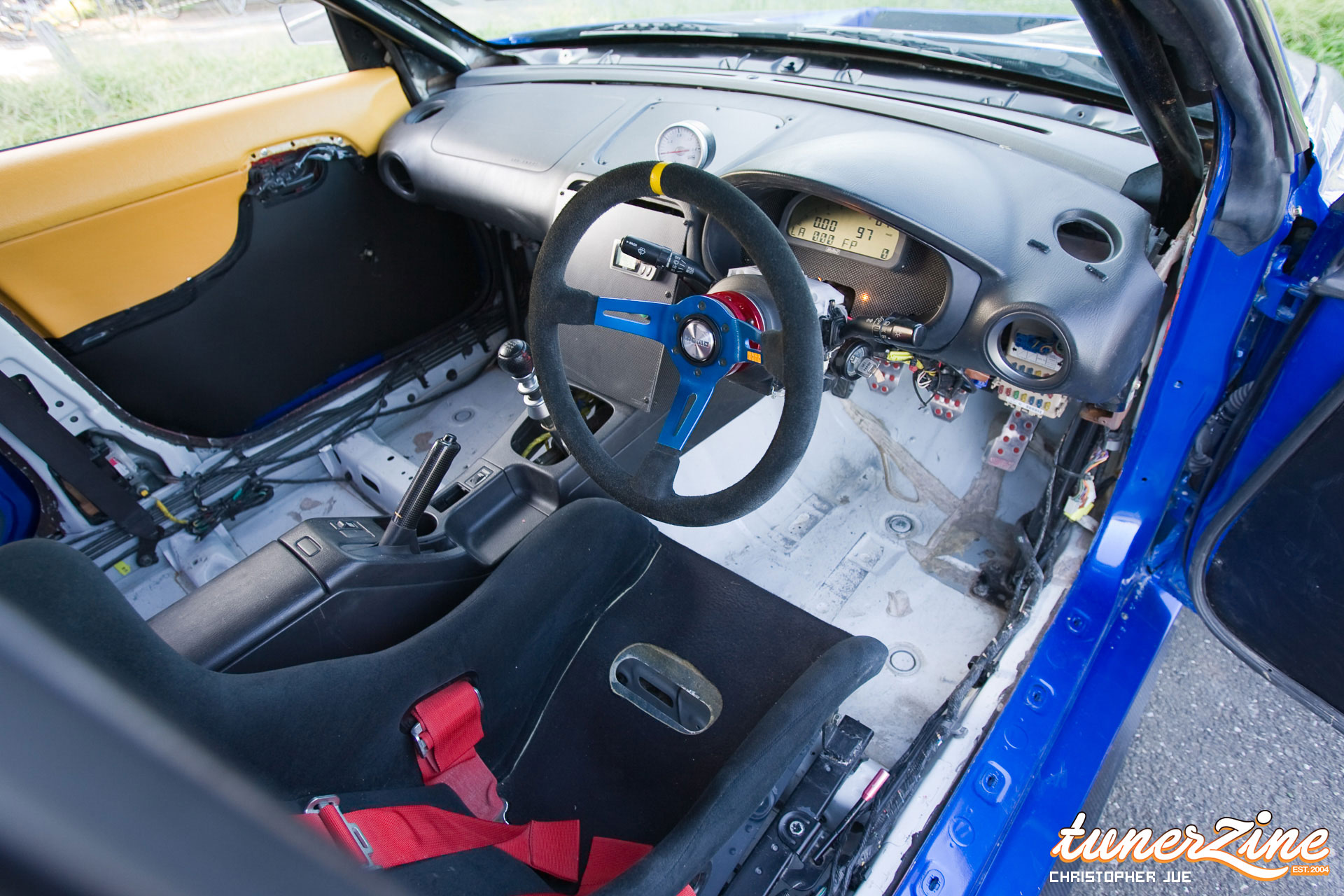
The bodywork is where the show car brief is most obvious, and nearly all of it came out of Hiro’s own shop: front bumper, rear bumper, hood, trunk, rear wing, front fenders, and front under spoiler are all Hiro originals, with Signal Auto side steps rounding out the aero. The biggest piece of fabrication, though, is the one that’s easiest to miss in photos: Nakamura chopped the roof. The entire roofline sits lower than stock, which is why the proportions look subtly off in the best way, with a shorter greenhouse and a more raked windshield than any GD that left the factory. A body kit can be unbolted. A roof chop is permanent, and it tells you how far the all-out brief actually went. Then the spec sheet takes a turn that no pure display build would bother with. The front doors are lightweight units, the rear doors are one-off FRP, the glass is acrylic, and the shell is fully spot and stitch welded. Add the Maruyoshi Sports six-point cage, a Hiro seat with a Hiro four-point harness, and the Defi Link gauges alongside the MoTeC dash, and you get a car that was commissioned to sit under show lights but was clearly built by someone who intended to use it.
GalleryPhotos by Christopher Jue