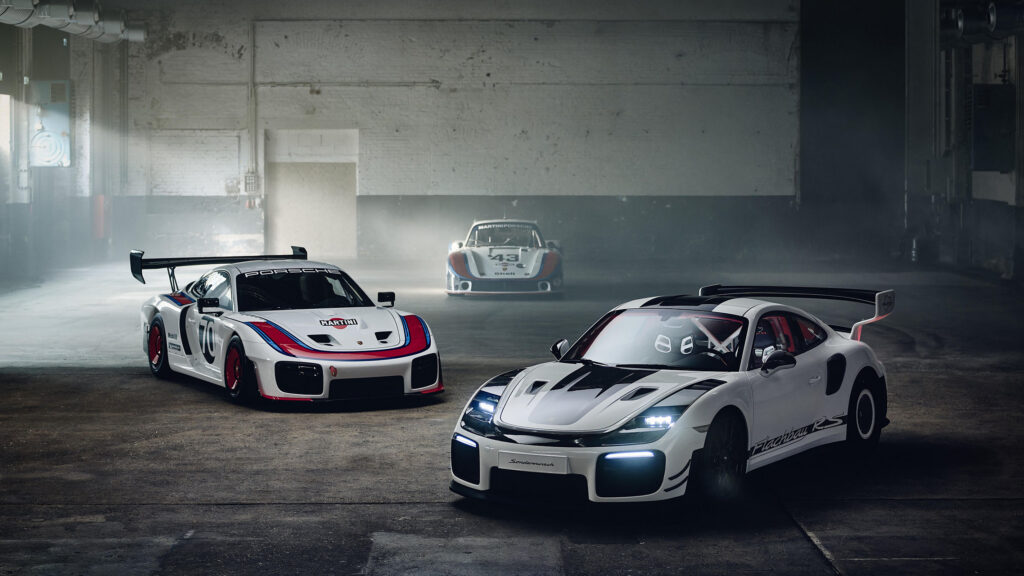
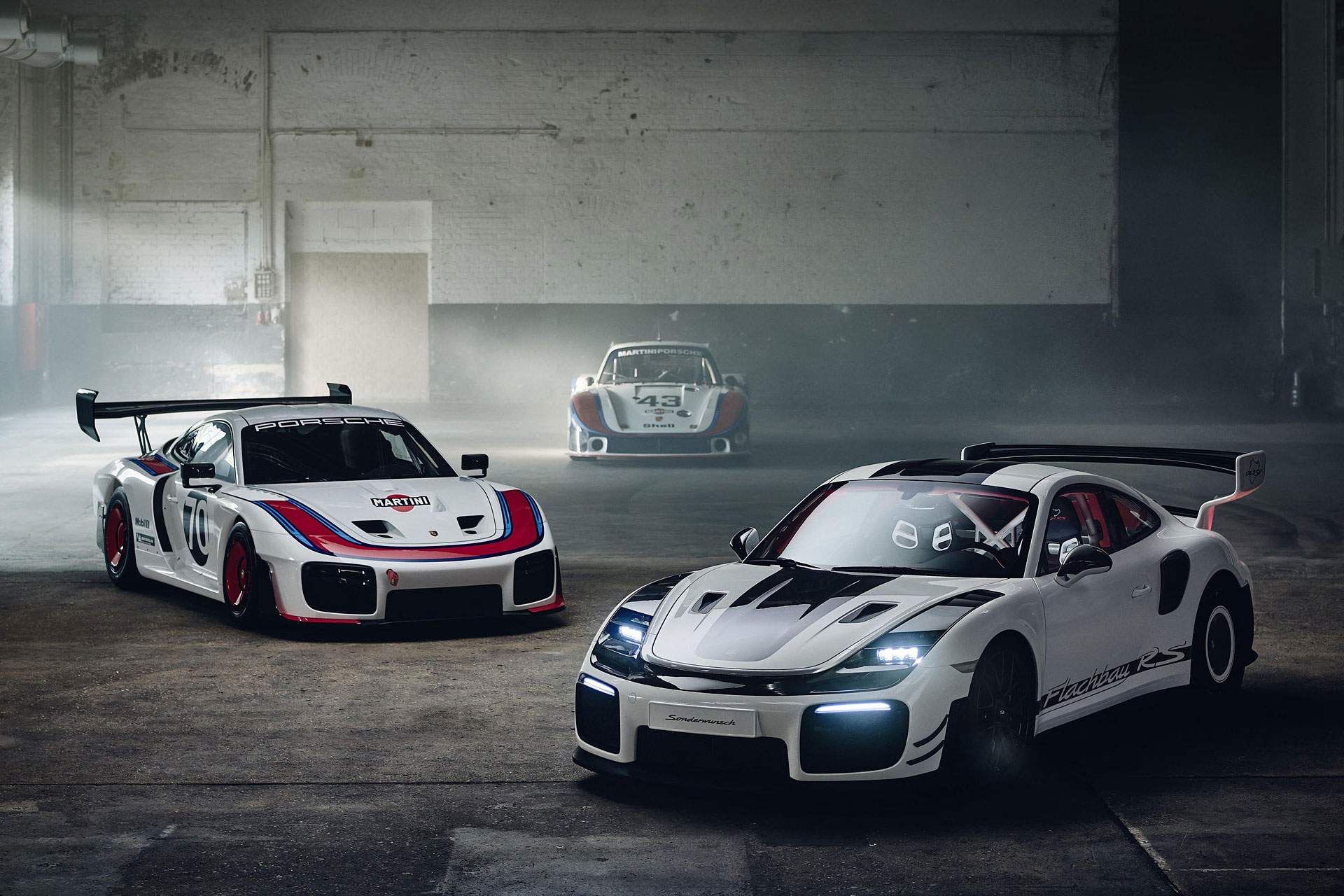
Porsche has revealed a one-off 911 Flachbau RS during Monterey Car Week, a road-homologated Sonderwunsch commission built from a like-new 2018 Type 991.2 911 GT2 RS with the Weissach Package. The project accounts for the Flachbau and Flachbau RS model designations Porsche registered with the European Patent Office in May 2025, and it was homologated for road use in Europe at the customer’s request.
A multidisciplinary team drawn from the Sonderwunsch department, Style Porsche, Weissach development engineering, Porsche Motorsport, and Manthey worked on the car for nearly three years. The powertrain was left unchanged in agreement with the customer, which leaves the twin-turbocharged 3.8-liter flat-six at 700 hp and 553 lb-ft. Lightweight measures removed close to 70 pounds from a car already built around weight reduction in Weissach Package form. Alexander Fabig, vice president of product offering and individualization at Porsche, said the aim was to reinterpret the 935 “without compromising on safety, technology or road legality.”
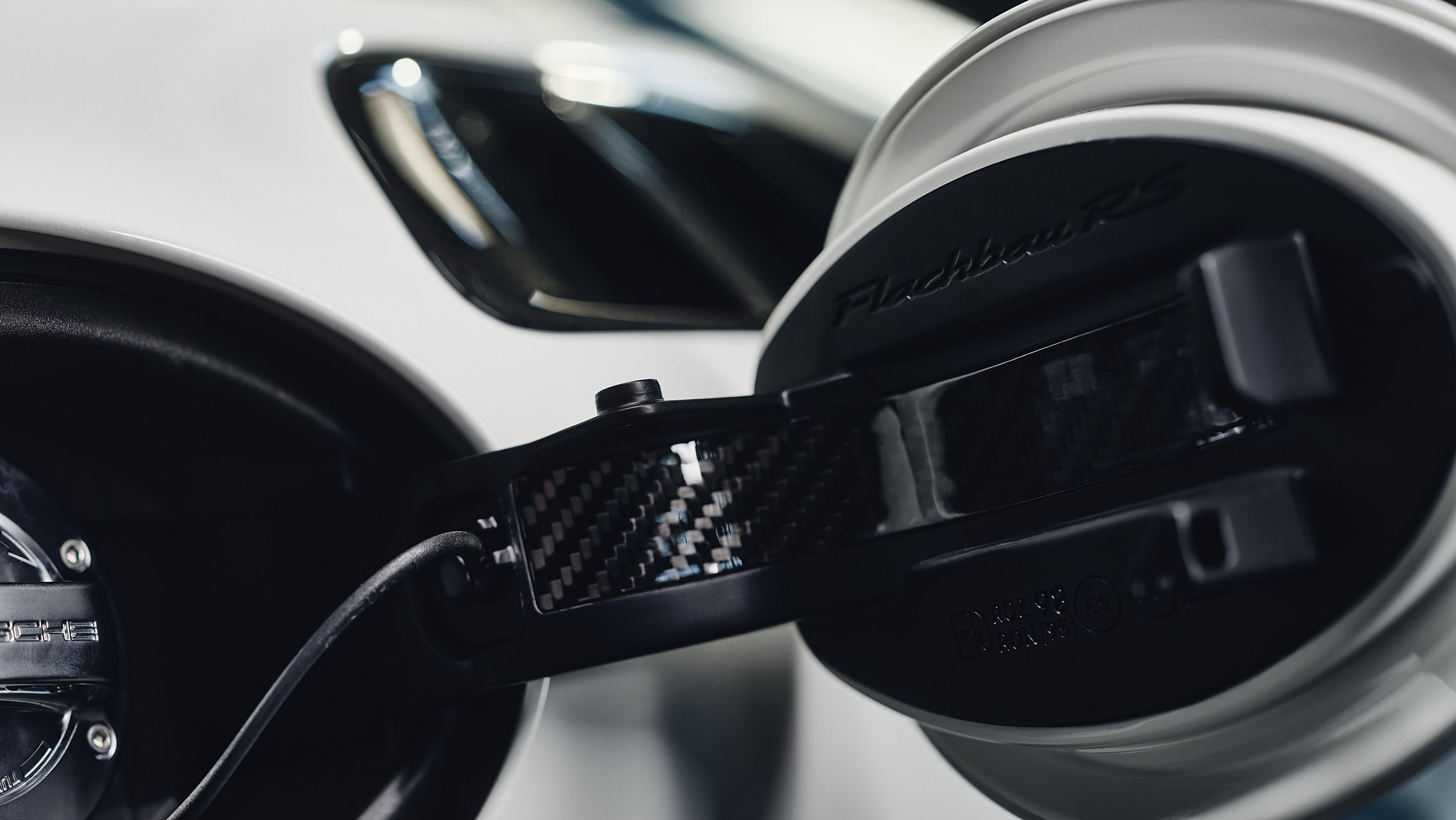
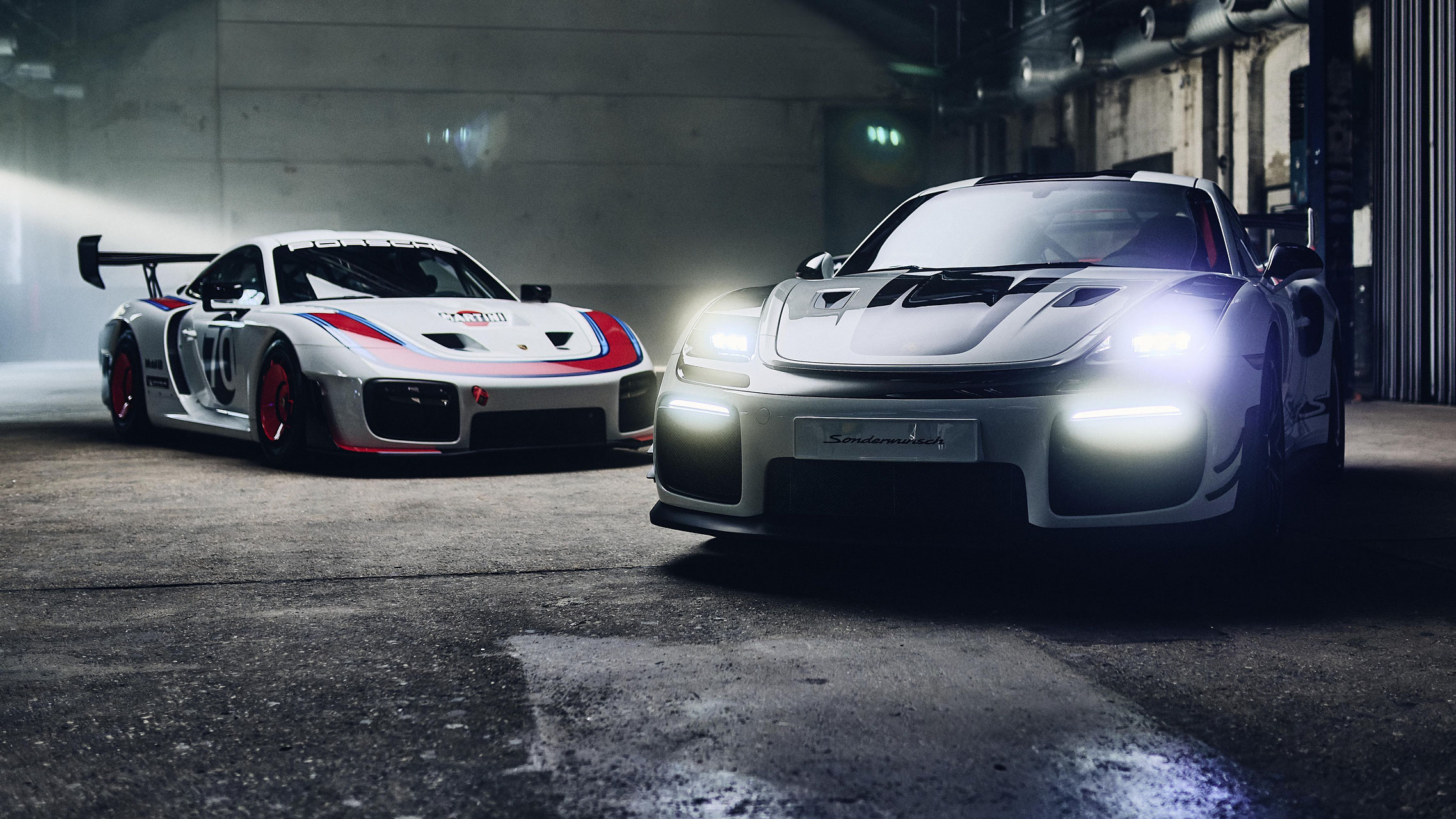
Exterior design was handled by Grant Larson, who is retired from Porsche AG and also designed the modern 935 the company presented at Rennsport Reunion VI in 2018. The front fenders sit lower and carry slatted louvers that vent the wheel arches and reduce pressure inside them, and the new fender contour required a redesign of the fuel filler flap and the mechanism underneath it. The front bumper is new and carries canards from Manthey. Standard round headlights have been replaced by three LED elements stacked in tiers for high beam, low beam, and daytime running lights, with the high and low beam units each measuring just under 1.5 inches tall and the daytime running lights under 0.78 inches.
The car is painted in Grand Prix White, a color Porsche introduced for the 911 in 1974, matched to a historic 911 from the Porsche AG collection. Black contrast sections and exposed carbon fiber run across the hood and roof, with the center stripe and a U-shaped element at the front rendered in visible carbon fiber. That U-shape references the Martini-liveried 935/78 the car is built after. The rear wheels wear carbon fiber aero discs finished in Grand Prix White, and the brake calipers are painted black.
The new rear wing takes its S-shaped mounts from the 911 GT3 R rennsport (Type 992) but sits almost two inches higher, and it can be manually adjusted between three positions. Porsche states that in the High Downforce and Low Downforce settings, rear axle downforce is two percent and three percent higher respectively than a 911 GT2 RS fitted with the Manthey Kit and its wing in the corresponding position. At a top track speed of approximately 211 mph in the High Downforce setting, the car generates roughly 1,221 pounds of downforce over the rear axle. The wing adjustment mechanism and its position markings are covered by patent. A front splitter works with the Manthey Kit underbody and rear diffuser.
Interior changes were concentrated behind the seats, where the cabin has been stripped in the manner of a race car while the front section retains its red Alcantara, black leather, and exposed carbon fiber. The Porsche Communication Management system was removed and replaced with a leather-trimmed storage compartment, and the audio system, most sound deadening, and the floor coverings in the cabin and luggage compartment came out as well. Exposed metal surfaces are painted Grand Prix White, and the rerouted wiring harness has been left visible under protective sheathing, with unused wires deleted. The carbon fiber bucket seats carry Flachbau RS embroidery on the headrests over a stylized Nordschleife outline, and a gold badge on the passenger side of the dashboard reads Werksunikat 2026 Flachbau RS. The warning triangle and towing eye, both mandatory for road use, now live in a removable box.
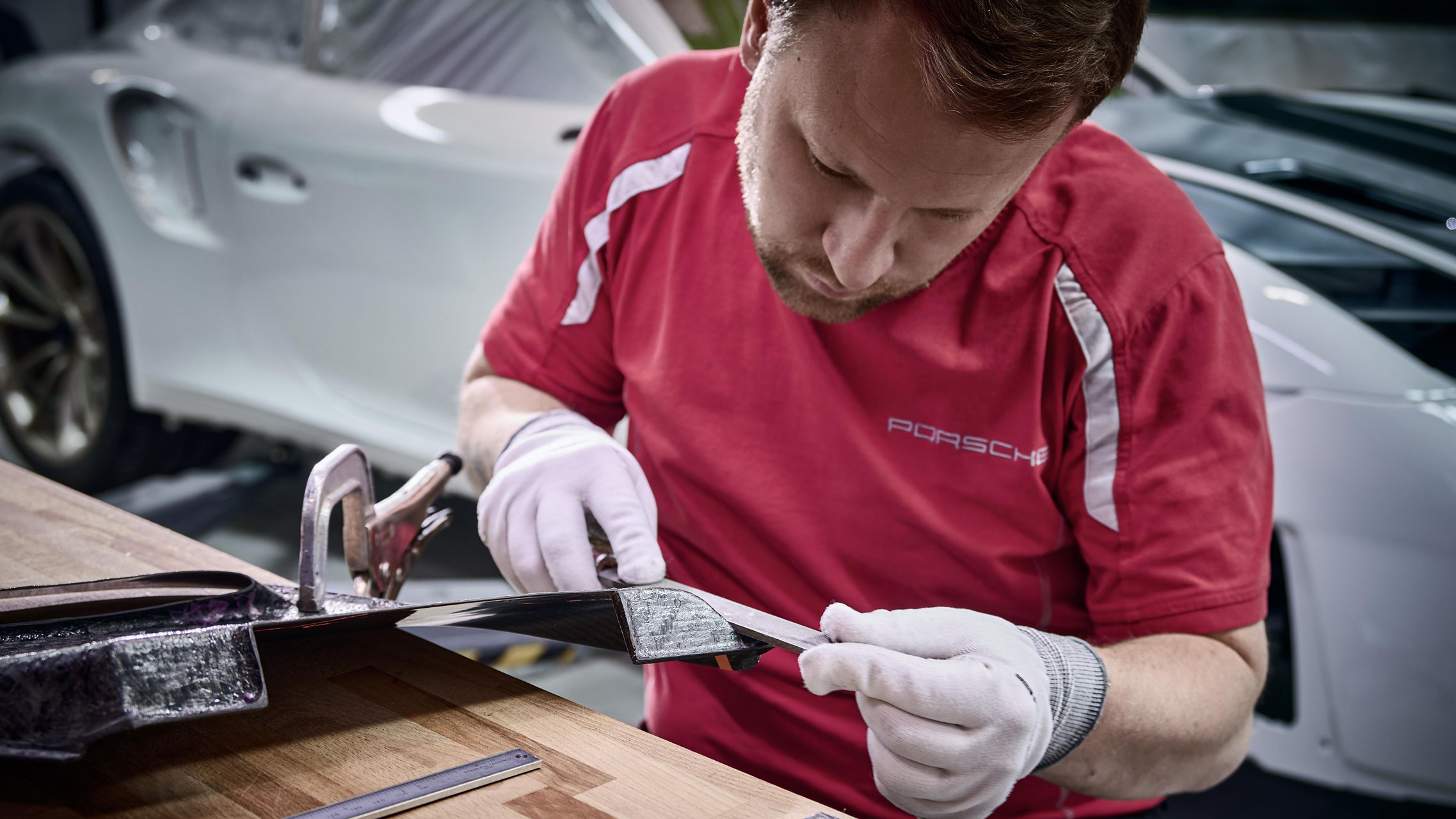
Porsche ran digital validation before tooling was approved, covering crash simulations, airbag deployment, structural analysis of rear wing loads, and CFD work. The wing was then run on a hydropulse rig for vibration and static load testing. Three test vehicles were built for lighting tunnel, wind tunnel, and road work, including runs at the Mendig airfield and 50 laps of the Nürburgring Nordschleife, with endurance testing simulating rear wing loads equivalent to about 93,200 miles (150,000 km) of customer use.
Flachbau bodywork has been tied to the Sonderwunsch program since the 1980s, when Porsche offered a Type 930 911 Turbo with redesigned front fenders and pop-up headlights based on the 935. Between 1982 and 1989, 948 examples of that version were sold. Porsche has not disclosed the cost of the Flachbau RS commission, and the car remains a single factory one-off.
GalleryPhotos by Porsche