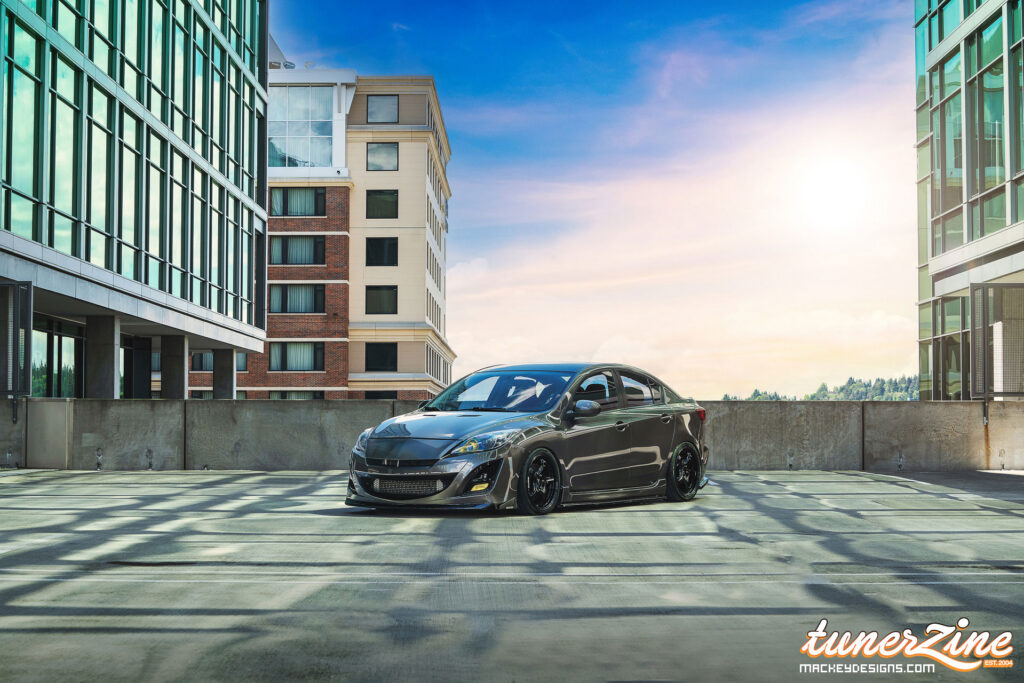
If you were reading Tunerzine in the early years, Josh Mackey’s name is already familiar. He was one of the photographers and contributors who helped shape what this site looked like back when we were still figuring out what it wanted to be, and a lot of the work that gave Tunerzine its early identity had his name under it. These days Josh runs his own automotive photography studio up in Seattle, but the car you are looking at started long before any of that, with a base-model Mazda3 and something to prove.
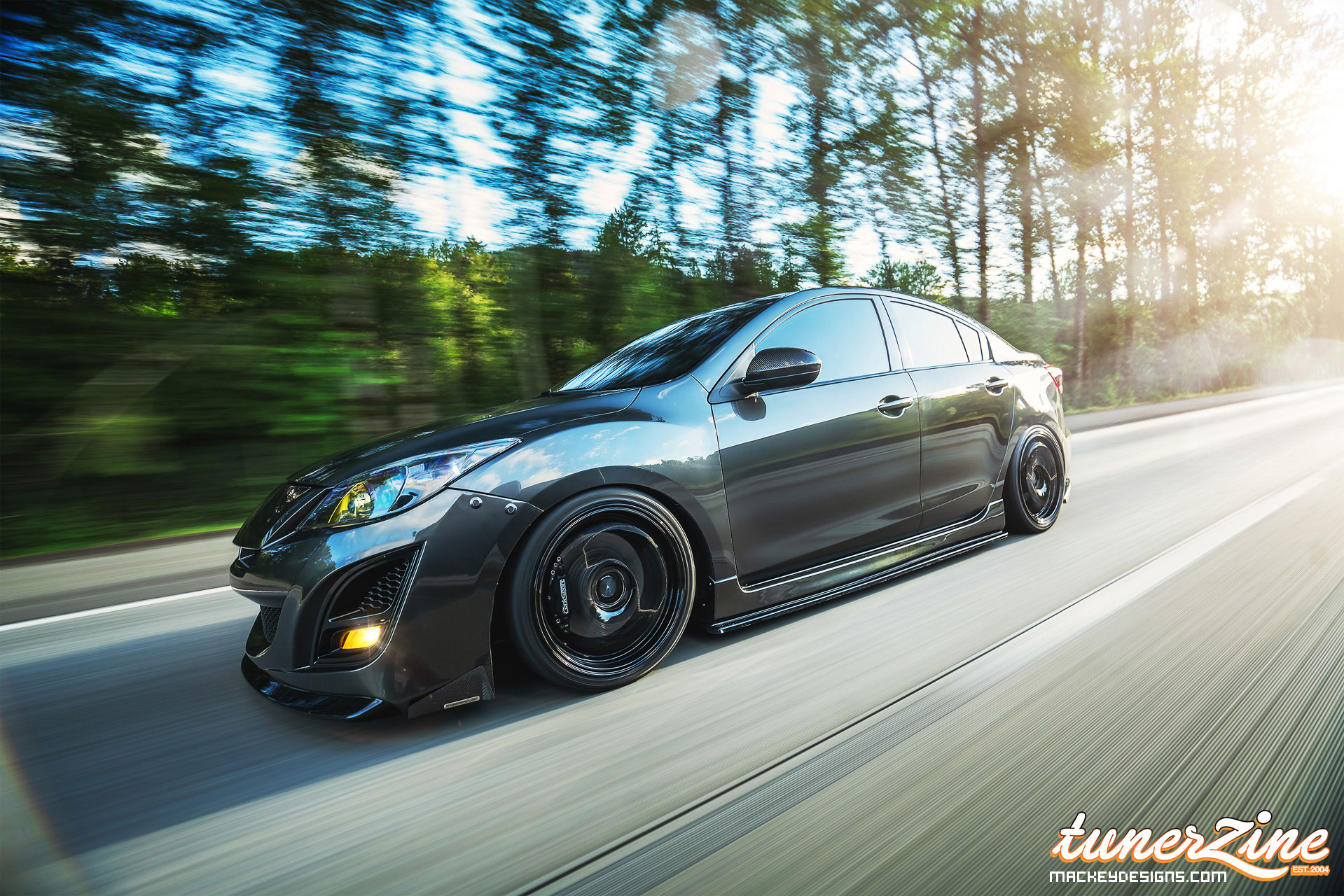
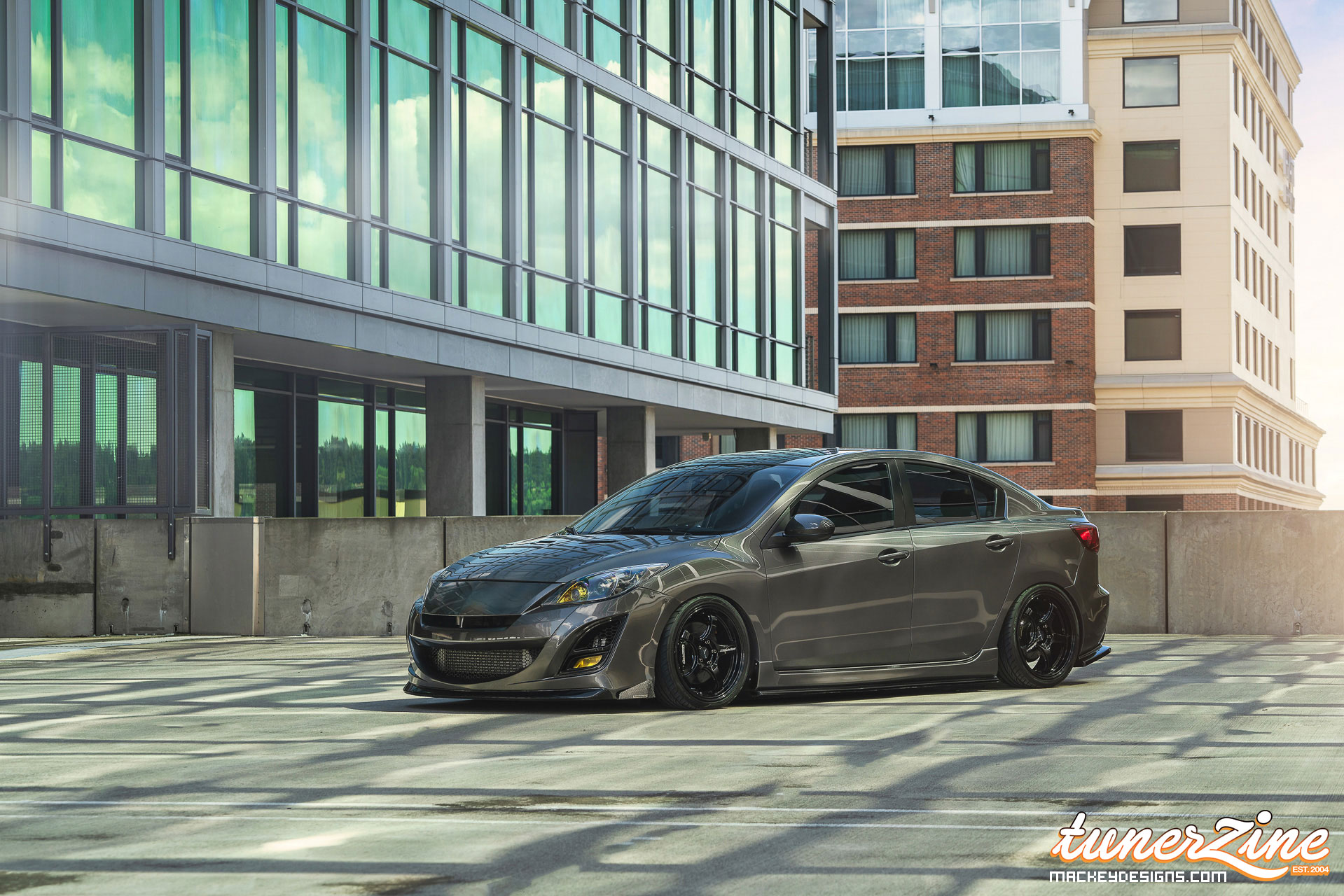
In a part of the country where the default project car is a Subaru or a lifted truck, Josh went the other direction on purpose. He picked a 2010 Mazda3 i Sport sedan (BL), the base car with the 2.0-liter Duratec and, of all things, a five-speed automatic, then set out to turn the least-loved version of the second-generation 3 into something nobody expected. He calls the approach OEM+, which is basically tasteful, factory-looking aesthetics layered over real street performance without giving up daily-driver function. Fourteen years and a little over 70,000 miles later, the Project3, as it came to be known across NWMotiv and then DailyDriven, is one of the more heavily documented Mazda builds on the internet.
Against the Grain
The obvious question, the one Josh says he fields constantly, is why not just buy a MazdaSpeed3. His answer is refreshingly unglamorous: at the time he couldn’t afford one, and he didn’t want a hatch anyway. So the plan became the harder version of itself, taking the slow automatic four-door and building it into something with presence and power, done deliberately in stages rather than all at once. The car has only ever been touched by industry professionals over its life, it has never been in an accident, and it still wears most of its original Graphite Mica paint, a gray that throws purple and green metallic depending on how the light hits it. Only the front end and trunk were resprayed during the build.
A Quiet Kind of Loud
Sticking to the OEM+ theme, the exterior reads clean before it reads modified. The factory plastic trim was refinished in gloss black for contrast, and the bodywork mixes an AutoExe front bumper with Mazda factory accessory side skirts and an M’z lip kit front and rear. The trunk was shaved and finished with a Mazda factory GT trunk lip, while the hood was customized with a set of proprietary 3D metal-printed vents that pull heat out of the bay. Servicing got easier with color-matched Quik-Latch quick releases up front, and the whole car was wrapped for protection at the nose and headlights, then Ceramic Pro coated courtesy of APC Auto Spa. Password:JDM carbon splitters and an APR Black Diamond exhaust tip round out the details, with 35 percent tint front and rear and 50 percent on the windshield.
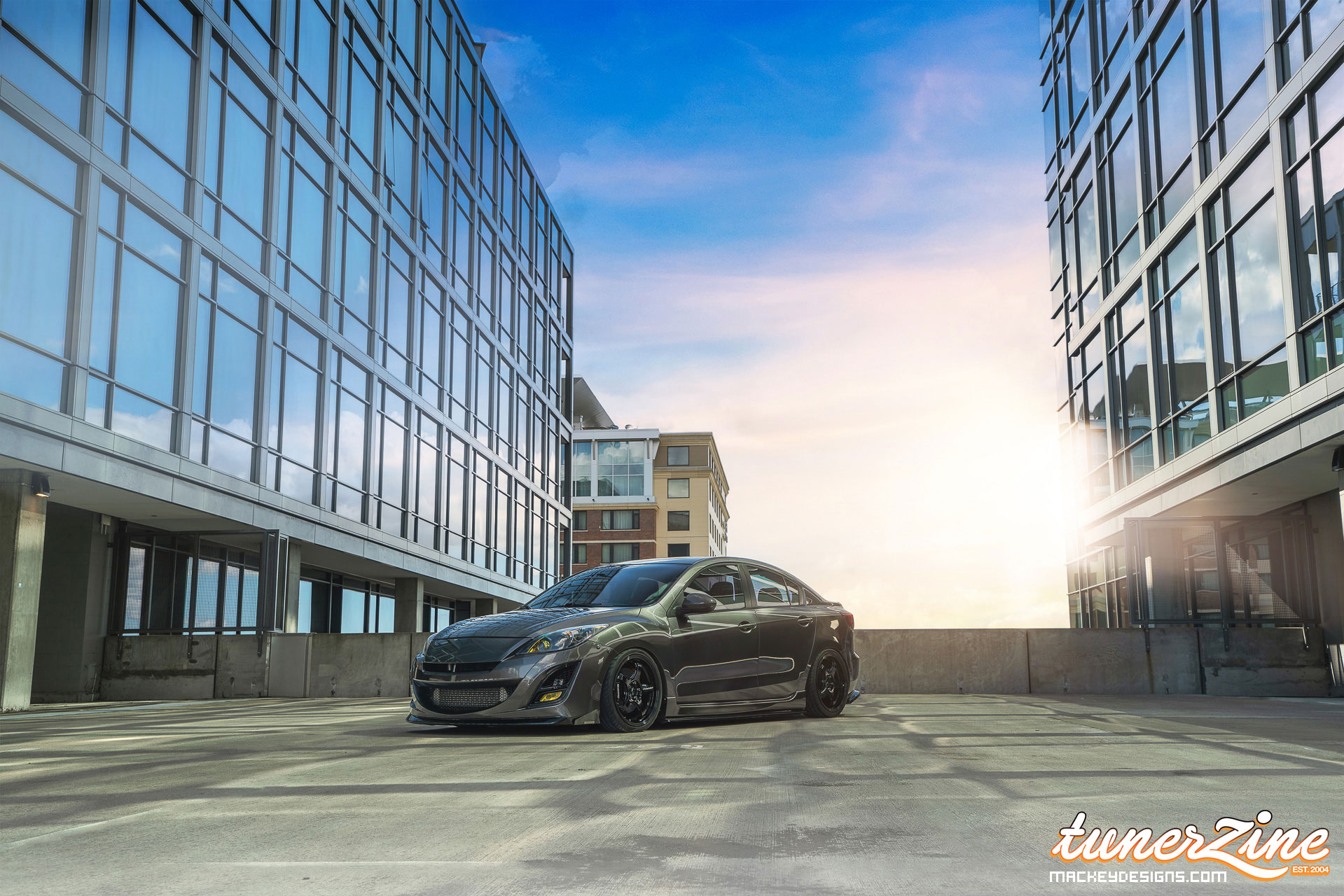
The lighting is where the restraint slips, in the best way. Working with The Retrofit Source, Josh built a set of headlights meant to look factory while performing nothing like it, each housing carrying a pair of Mini H1 7.0 prototype projectors alongside custom bi-xenon projectors with a diamond-pattern etching. The housings wear black and metallic-yellow paint with carbon trim inside and Mazda3 GT Tech Package clear corner markers. Out back, the taillights were given a three-stage candy red and smoke treatment to step away from the clear-lens trend, and the rear bumper runs CorkSport LED lenses. Diamond Lighting handles the fogs, corner LEDs, reverse and brake bulbs, and a set of custom puddle lights.
Boost Logic
From the factory, the 2.0 Duratec makes around 140 horsepower, which Josh is quick to note will not even break the suspension loose. Off-the-shelf power for this platform basically didn’t exist, so he had to get resourceful. In partnership with Tam Le at Tam-Tech Auto and Daniel Routley at DRTuned Racing, he sourced the remnants of an older and very rare Reactive Racing turbo kit and built a one-off system around them. That means a custom turbo manifold, intake pipe, downpipe, oil feed lines, intercooler piping and front-mount intercooler, all built to fit, feeding a BorgWarner AirWerks turbo. A Turbosmart blow-off valve and external wastegate on a 7 psi spring, Bosch injectors, and a Haltech Sport 1000 manage the rest, with a cold-air intake and a CorkSport Power Series exhaust handling the standard bolt-on duties.
Keeping it alive at temperature is its own subsystem: the custom hood vents pair with a Koyorad Racing aluminum radiator, a turbo heat shield and wrapped piping. An XS Power battery hides in a CorkSport relocation box hydrodipped in carbon, a texture Josh repeated on the engine cover, alongside Password:JDM carbon shrouds and titanium hardware to dress the bay. None of it is a simple bolt-on. The fabrication, the wiring integrated with the stock ECU, and the tuning from DRTuned are all bespoke. Because the stock five-speed automatic is the weak link, boost is currently capped at 7 psi, and in this form the car puts down around 225 hp at the wheels, which Josh figures at roughly a 60 percent jump.
Planted
The Mazda3 was always a willing chassis, and Josh leaned into that before chasing power. BC Racing BR coilovers anchor the setup, combined with a full CorkSport suite that covers a front strut bar, front and rear sway bars, front and rear end links, rear camber and toe arms, and a skid plate. Whiteline front and rear bushing sets plus a bump steer corrector sharpen the feel further. Braking moved up to a CorkSport front big brake kit with EBC slotted rotors and Red Stuff pads front and rear, stainless lines and Motul 5.1 fluid. Sitting under the arches is a set of WedsSport RN-0RM in 18×8 +35 gloss black, which Josh believes was the first set to land in the United States, wrapped in Yokohama S.drive 215/35/18 and held on with Muteki titanium spline-drive lug nuts.
Cockpit Theory
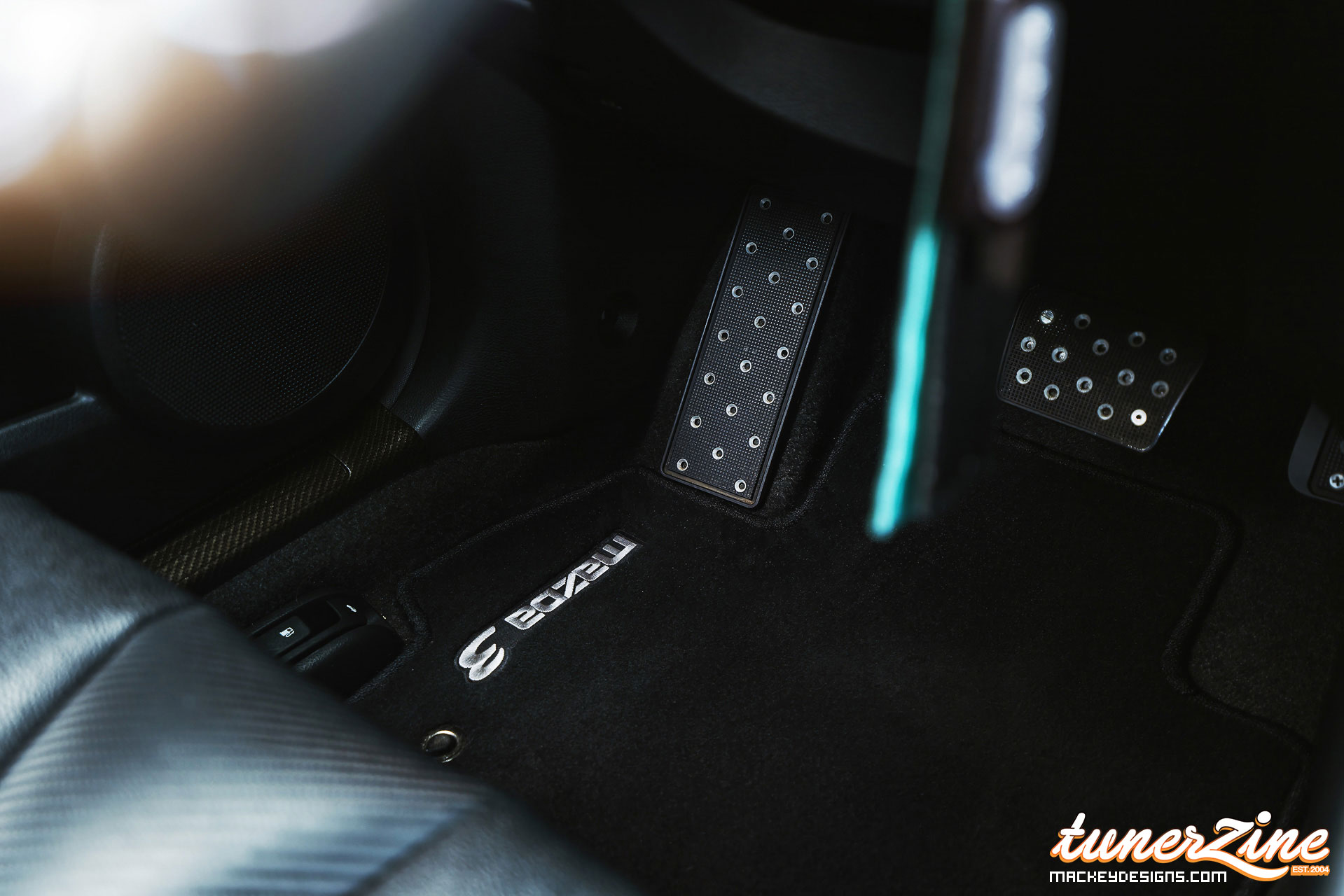
For the interior, Josh took inspiration from the first-generation Acura NSX, a cabin he describes as feeling like a proper cockpit. That shows up in anthracite suede across the pillars, headliner and door cards, and in the way the controls are arranged. Rather than a stock pillar gauge cluster, he worked with Ortiz Custom Pods on factory-looking molded pods, a double pod on the steering column and a triple on the center console, holding a mix of Defi and AEM gauges. The CorkSport racing steering wheel, the pods, the console and the rest of the trim are all hydrodipped in the same carbon texture as the engine pieces to keep the design consistent. Braum Racing Elite seats in black and carbon sit on Planted brackets, backed by a Braum harness bar and harnesses, while the rear seats and door cards were redone in Katzkin leather and perforated suede. The smaller touches add up: Napa leather shift and e-brake boots, SRP Racing pedals, a carbon iPad mount, and a rare Raceseng x DailyDriven Mint Ashiko shift knob.
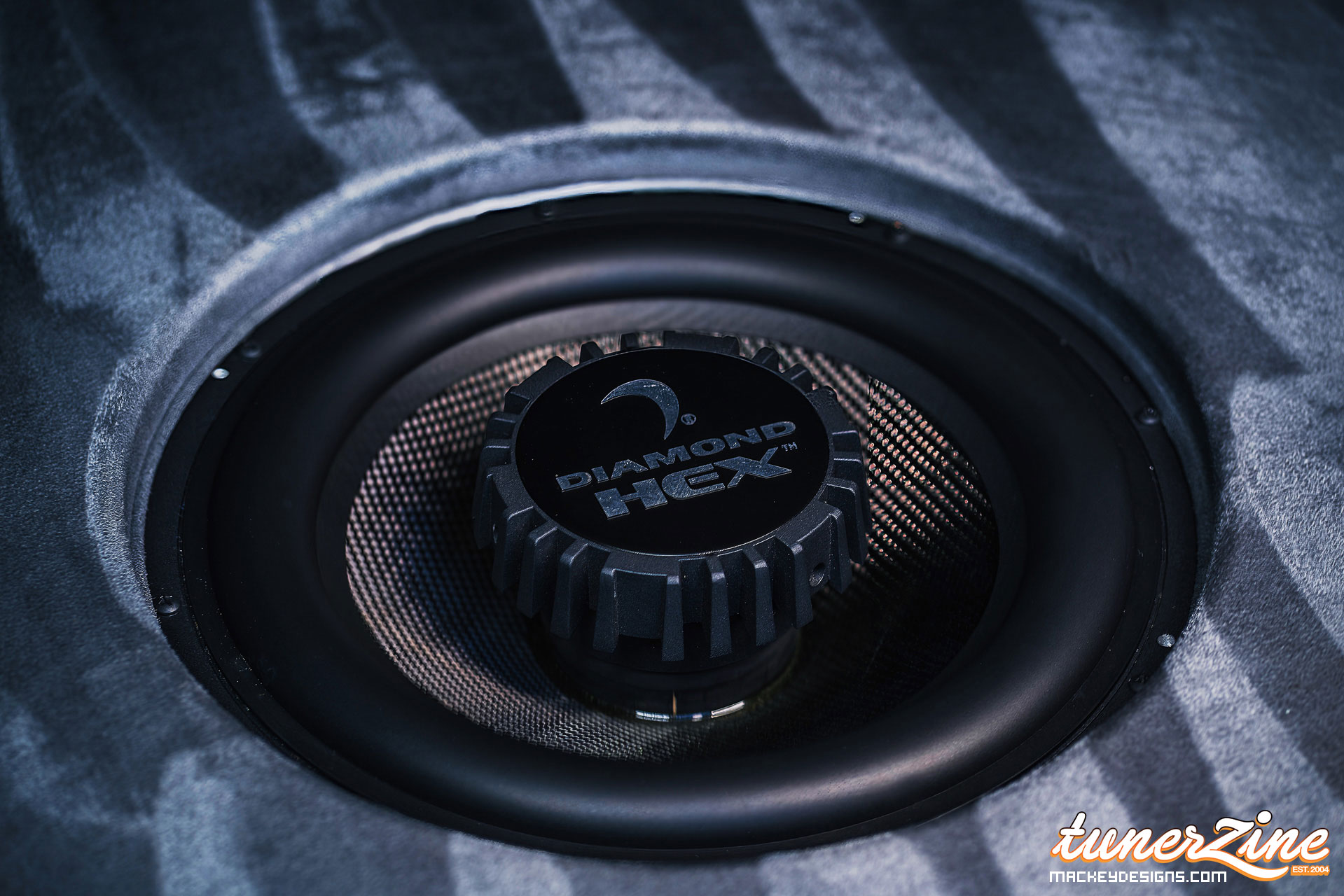
The audio follows the same hidden-in-plain-sight logic. The car was stripped and layered front to trunk with ballistic sound deadening before a single speaker went in, and everything routes through a Kenwood DDX-9902S head unit with CarPlay and Android Auto. Diamond Audio D6 components live in the front and rear doors, a suspended trunk rack holds a D600.4 four-channel and a D400.1 mono amp, and a 12-inch HEX subwoofer sits in a custom fiberglass and MDF enclosure built into the spare-tire well, wrapped in matching suede and tucked under the factory trunk carpet so the paneling still looks stock. A Compustar DroneMobile system handles security.
GalleryPhotos by Josh Mackey