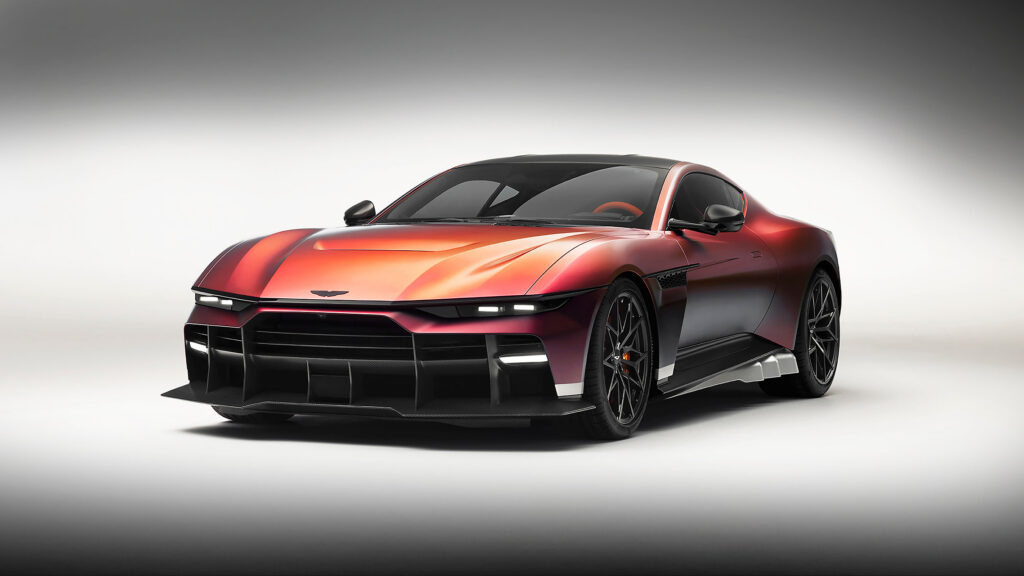
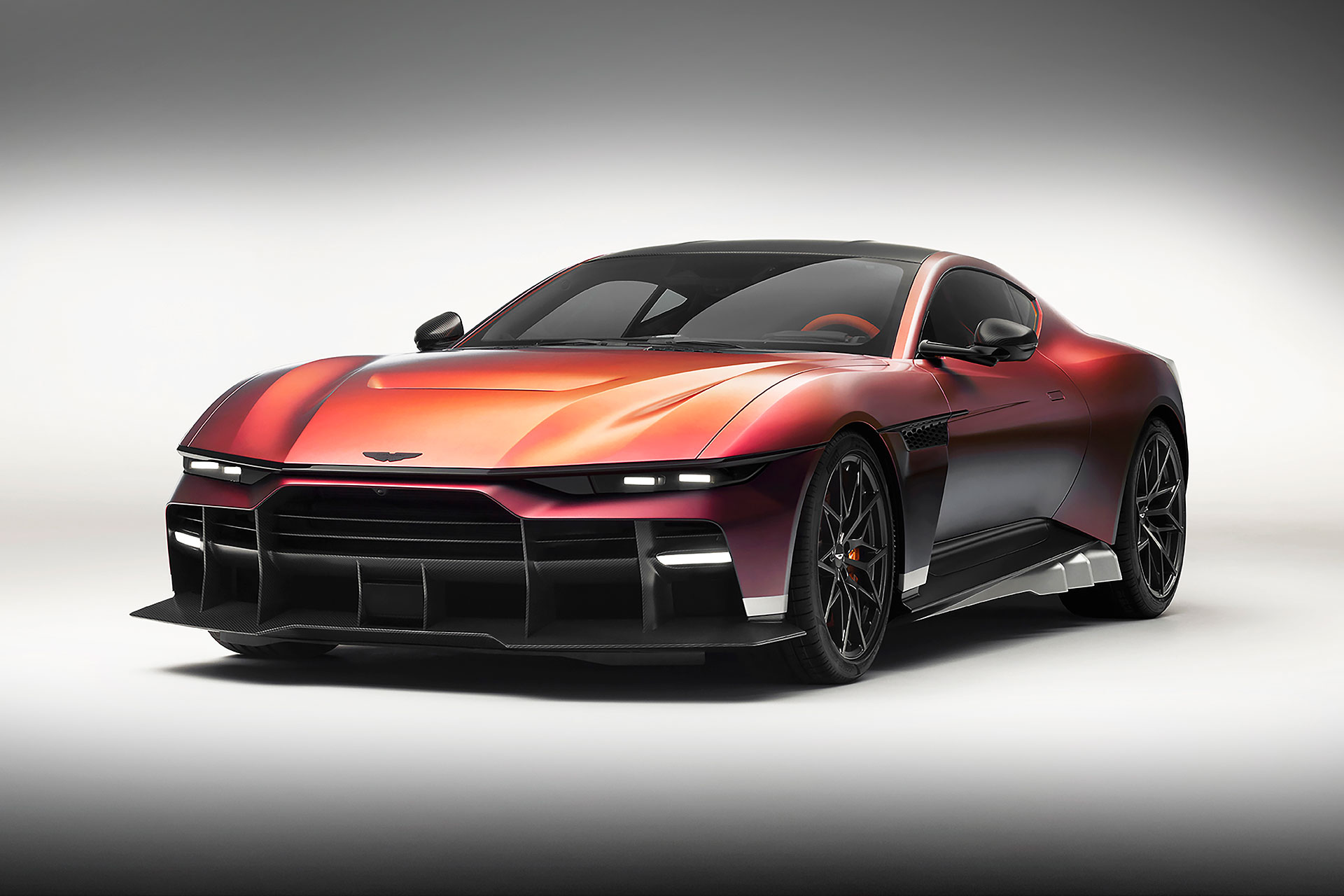
Aston Martin has revealed the Valen, which the company calls the world’s most powerful front-engined production car and the most powerful front-engined V12 supercar in its 113-year history. The car wears a full carbon fiber body, production is limited to 150 examples, and first deliveries are scheduled for the second quarter of 2027.
Power comes from the most potent version of Aston Martin’s 5.2-liter twin-turbocharged V12, producing 838 horsepower (850 PS) and 738 lb-ft (1,000 Nm) of torque from 2,500 rpm. The engine is paired with an eight-speed ZF transmission running shift strategies developed for the company’s Vantage GT4 race program, and Aston Martin quotes a 0-60 mph time of 3.0 seconds with a top speed electronically limited to 214 mph.
The Valen name derives from the Latin word valens, meaning strong or powerful, and continues the company’s line of V-named limited-production specials. The project comes from Q by Aston Martin, the bespoke division behind the Valour, Valiant, and DBR22, and was developed through the company’s newly formed Special Vehicle Operations department.
Weight reduction was a central focus of the program, with the Valen saving up to 242 pounds (110 kg) over Aston Martin’s core V12 platform through the use of carbon fiber, aluminum, titanium, and magnesium. An optional lightweight pack with machined-from-solid aluminum suspension arms and knuckles plus titanium chassis bolts cuts another 37 pounds (16.9 kg). Lightweight magnesium wheels are standard, wrapped in Aston Martin-tuned Pirelli P Zero R tires measuring 275/35ZR21 front and 325/30ZR21 rear, with P Zero Winter 2 tires also developed specifically for the car. The Valen adopts Pirelli’s Cyber Tyre technology, developed with Bosch Engineering, which feeds real-time tire data to the ESP, ABS, and traction control systems so they can continuously adapt their thresholds.
The chassis uses a solid-mounted rear subframe, model-specific springs with helper springs, and Bilstein DTX semi-active dampers, while the drive mode lineup runs Sport, Sport+, and Track. Throttle mapping changes by mode, with Sport and Sport+ using a shorter map that delivers more throttle earlier in the pedal travel and Track mode trading that urgency for a longer, more progressive delivery. Braking is handled by 16.1-inch (410 mm) front and 14.2-inch (360 mm) rear carbon ceramic discs behind a booster tuned to keep a firm pedal.
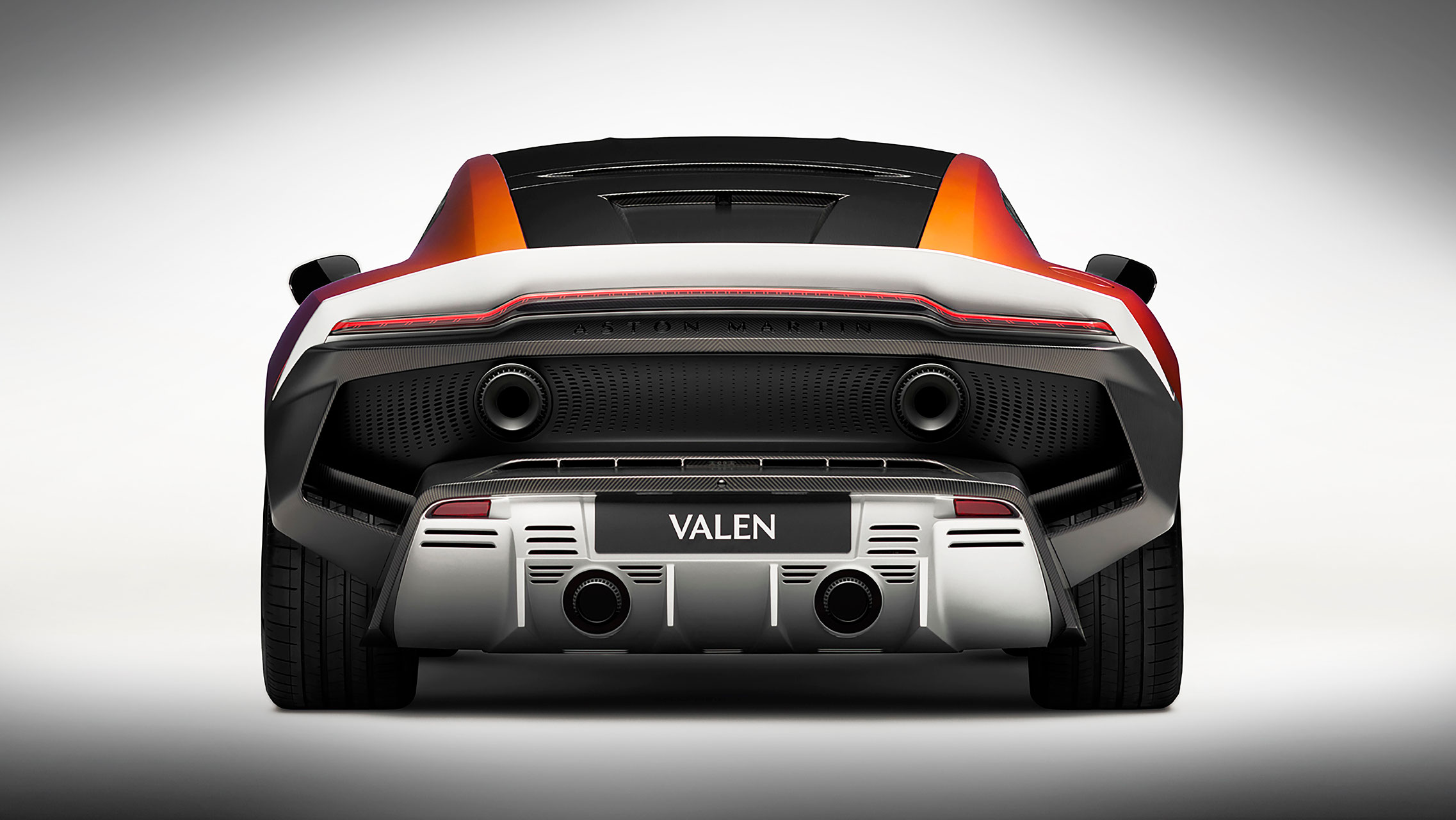
A new lightweight titanium exhaust system runs four tailpipes split between two upper and two lower outlets, with the tips formed from 3D-printed titanium. The upper exits are always open while the lower exits are valved by drive mode, and the system uses new micro mufflers for homologation compliance. Aston Martin says the sound tuning reduces lower frequencies while amplifying higher tones, with the upper outlets tuned to generate resonance at higher engine speeds.
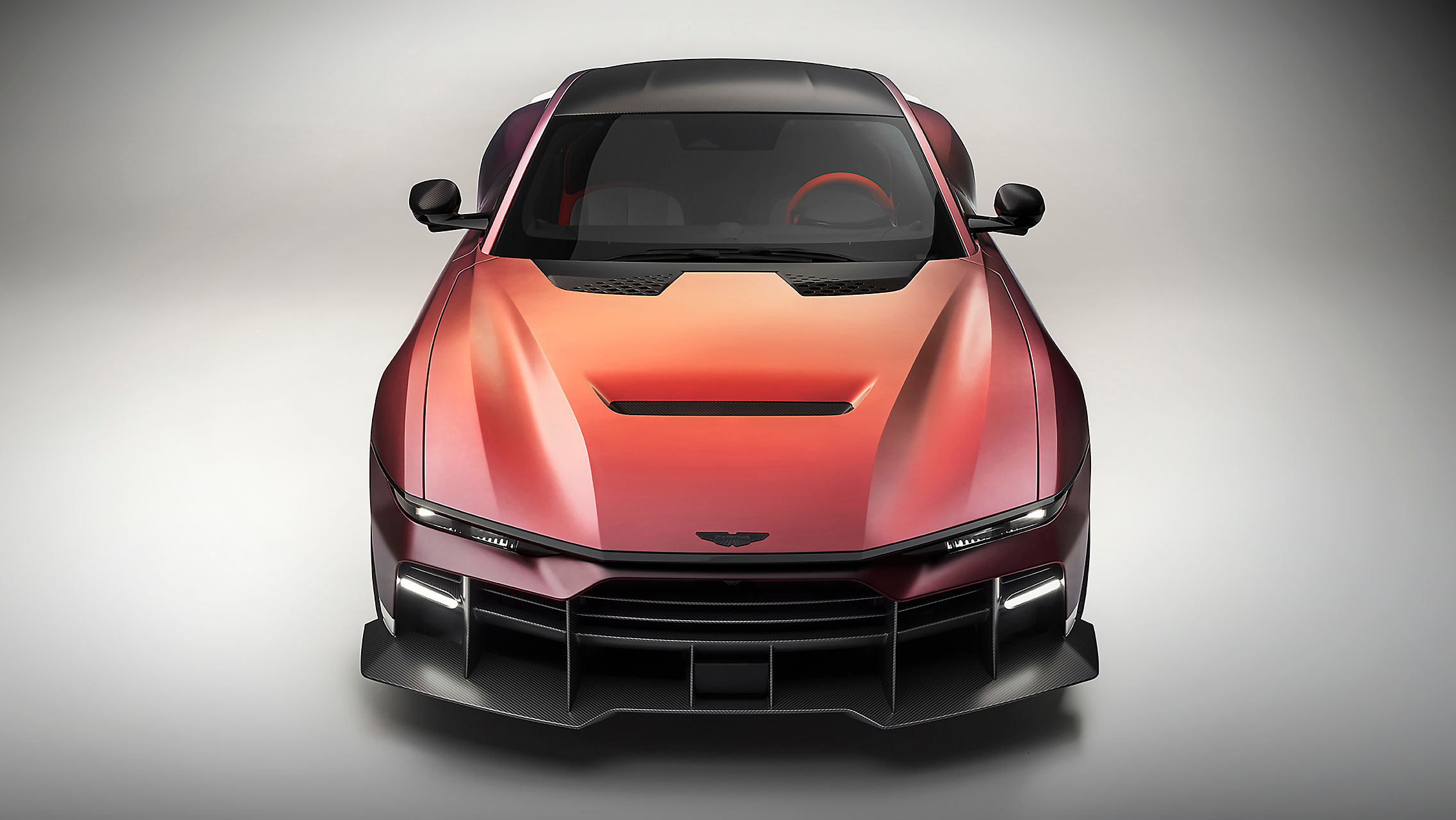
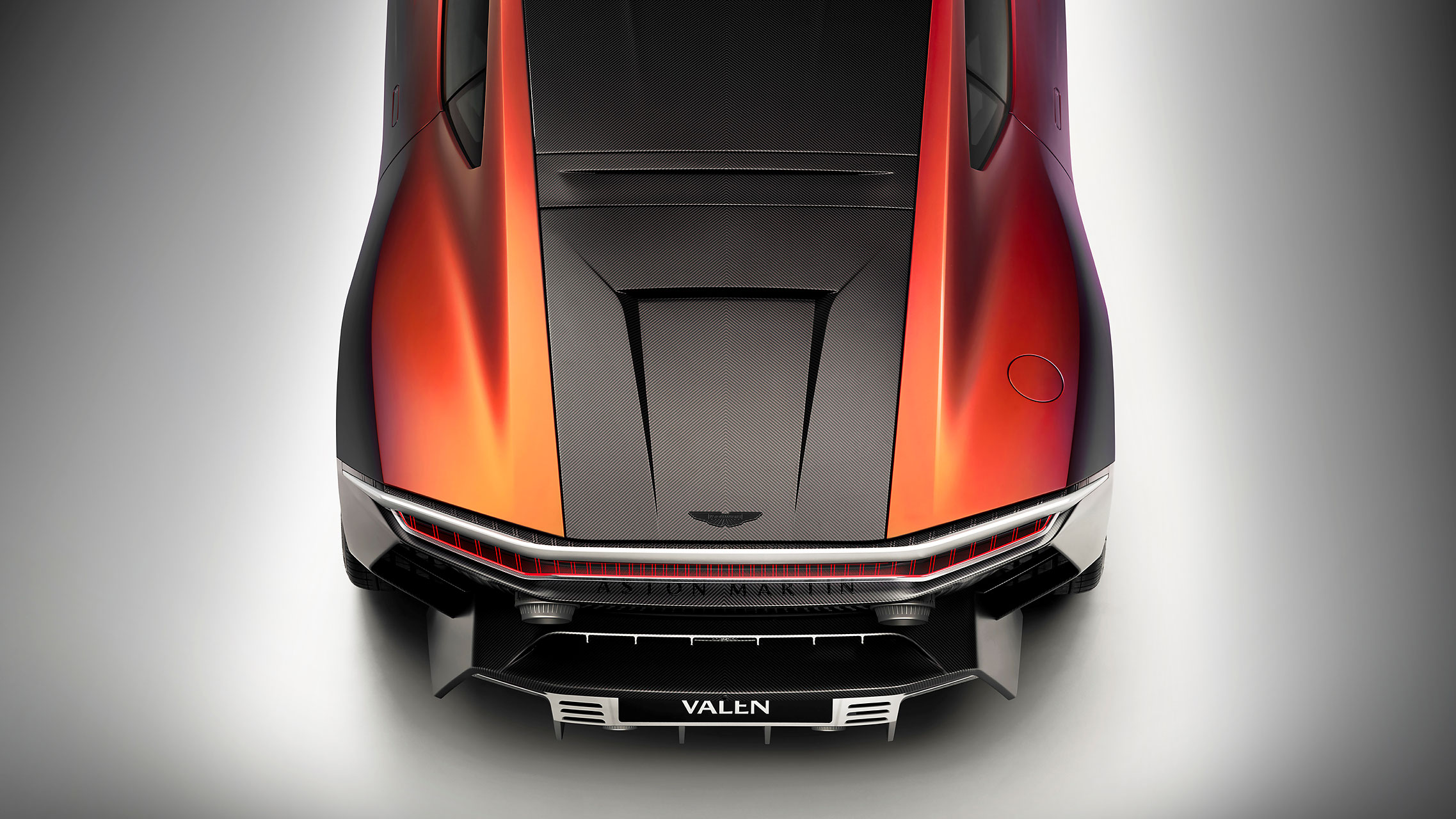
The exterior design features deeply recessed slimline headlamps beneath a plunging hood line, an angular grille treatment, and an acutely angled front splitter. Elongated side strakes are incorporated into functional vents that extract air from the wheel arches, stepped sills carry saw-tooth vortex generators to reduce lift, and new quarter windows reshape the profile. At the rear, a solid tailgate replaces the fixed rear window and trunk lid, incorporating an aerodynamic wing and opening onto a 6.0-cubic-foot (170-liter) trunk with an optional Touring Pack luggage set. The upswept tail acts as a Gurney flap to generate downforce without a motorsport-style wing, sitting above a full-width light bar. The show car is finished in Satin Andromeda Red, a Q-developed color, and customers can also option a fully exposed carbon fiber body with tints available in satin and gloss finishes.
Inside, a slim center console built with 3D-printed components carries the switchpack introduced on the Valhalla, angled toward the driver. Buyers choose between newly developed Sports Plus seats or lightweight carbon fiber performance seats, along with a trim hierarchy starting with semi-aniline leather with Alcantara or full semi-aniline leather across five material splits.
Aston Martin Valen | The Most Powerful Front Engine Supercar
GalleryPhotos by Aston Martin