It’s strange to think drifting was once the underground, “if you know you know,” sector of motorsports. It surfaced through that one friend who somehow had a VHS or DVD copy of “Drift Bible,” or “Video Option,” directly from Japan—a time less remembered, before the internet’s primacy.
These videos offered a glimpse into a world of wild liveries and unique auto styling on famed platforms like Nissan’s S-chassis, Toyota’s AE86, and Mazda’s F-chassis. These builds caught attention in the United States around the late 1990s and early 2000s.
Import drag racing was having its moment in the sun. Young enthusiasts were catching up to big-block V8s and their blistering quarter-mile times—with half the displacement. The craze would taper off as large American manufacturers entered with even larger budgets, cracking open the sport compact drag racing segment.
Fewer import racers could afford to compete at the highest level. By the mid- to late-2000s, the scene had slowed, a victim of its overnight craze.
While import drag racing lost popularity on American tracks, enthusiasm for Japanese cars was only beginning.
Press Play
Like many, former Formula D driver Calvin Wan began humbly, in a front-wheel-drive car. “I was dragging the e-brake around here and there, doing little corners—whatever you could do at the time,” Wan said with a laugh.
Wan grew up in San Francisco, getting into import drag racing with a DSM throughout the mid 1990s. In 1998, he got his first Toyota AE86. At his first Hachi-Roku meet in Daly City he met Antonio Alvendia, who would become a longtime friend
“I was figuring out how to drift based on watching Option videos,” Wan said. “We didn’t really have anyone who knew how to drift back in the late ’90s, and there were no drift events. You’d go where you had to go and learn on your own.”
Without dedicated events, Wan and his peers had few opportunities to learn on track. He described the community’s progression as “very slow,” given those limitations. “We had to drive in the mountains and open lots. There was no facility to learn in. We would try to drift at autocross events and get kicked out for sliding the car around. We’d try to sneak it in at track days on road courses too, but got black flagged,” he continued.
Wan moved into a Mazda RX-7 (FD3S) in 2000. In 2002, he discovered Speedtrials USA—his first real introduction to drifting on track.
“It was a track day, but they had one run group that was a car-control clinic/drift run group—I entered that in 2002, it was held at Buttonwillow Raceway, I was driving my RX-7, and that was my first-ever drift event, which got me hooked on drifting and I never looked back,” he continued.
“The following year, I attended my first drift competition, which was an invite-only event I found out through the Club4AG forum,” Wan recalled. Alvendia had introduced him to Moto Miwa’s famed AE86 forum, where he learned about the Video Option Ikaten, held on January 17, 2003, in the parking lot at Irwindale Speedway. “That event got me determined to become a better drifter.”
Club4AG formed Drift Association and held frequent Drift Day events around this time, that really provided the first wave of U.S. drifters a place to safely learn how to drift on controlled parking lot courses on the West Coast of the United States.
“These first events in ’02 and ’03 were one of the first-ever drift events in the U.S. We had a very small, tight-knit community, and we were all learning together at these early events,” said Wan.
Drift Showoff
Falken Tires, in tandem with Mainstream Productions, hosted the first “Falken Tire Drift Showoff” on March 2nd, 2003. This drift competition took place in Irwindale Speedway’s parking lot located in Irwindale, California.
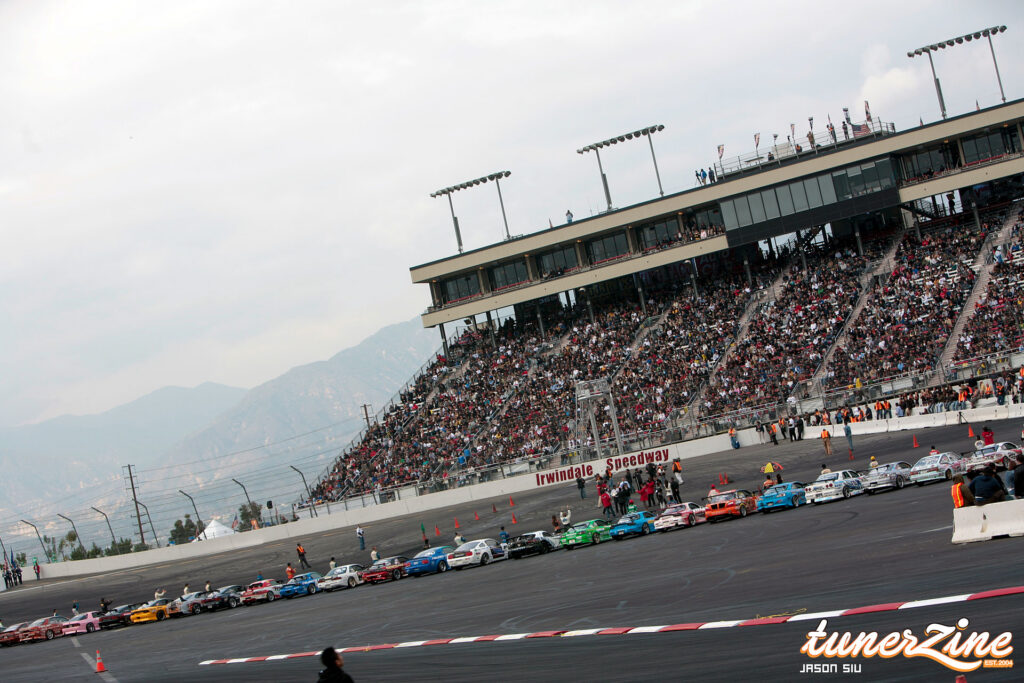
“That was the first mainstream big drift event open to the public,” Wan said. “A bunch of media came out that day. At the event, no one brought properly tuned drift cars to compete with—most were street and show cars. The level of tuning in the U.S. wasn’t nearly as knowledgeable as the Japanese drift cars,” he explained.
Wan recalled watching Japanese drifting heroes Yoshinori Koguchi in his S13 and Seigo Yamamoto in his JZX100 Chaser, brought over by Team Falken, to perform drift demos for the first time in the U.S. at this event. Signal Auto also brought over its S13 and S15 as “properly tuned drift cars, driven by Fumaki ‘Drifter X’ Komatsu and Kazuya ‘Chunky’ Bai.”
“Those were properly done-up drift cars from Japan, with real drift drivers professionally competing in D1 Japan. It blew our minds—the level of drifting Japan was at. That was our first time seeing real drifting in person,” he said.
Wan also mentioned Manabu Orido’s Toyota Supra drifting Irwindale’s big bank for the first time at the RS*R Drift Festival on April 6, 2003, among the memorable early builds. The star-studded lineup of Japanese heroes arriving at events during this period left a deep impression on their U.S. counterparts, they were witnessing firsthand how much they had to learn.
“All of us in the U.S. were like, ‘Whoa, okay. We’ve got to step up and learn from them.’ They really showed us how it was done,” Wan recalled.
While 2003 brought exhibitions with notable Japanese drivers, competition was still to come.
D1GP Competition Experience
The first U.S. D1GP driver search occurred on June 15, 2003. “I was one of eight drivers in the U.S. to first be awarded a D1GP license by Keiichi Tsuchiya, that was huge at the time,” explained Wan. “That opened the door for sponsorships, leading up to the big event.”
The Japanese lineup was stacked with living legends. Wan described himself as “blown away,” recalling his introduction to professional preparation. “A’PEXi did an independent professional test day—exclusive for its sponsored drivers and friends. A’PEXi Japan brought its driver Youichi Imamura to test A’PEXi United States’ newly built LHD FD3S.
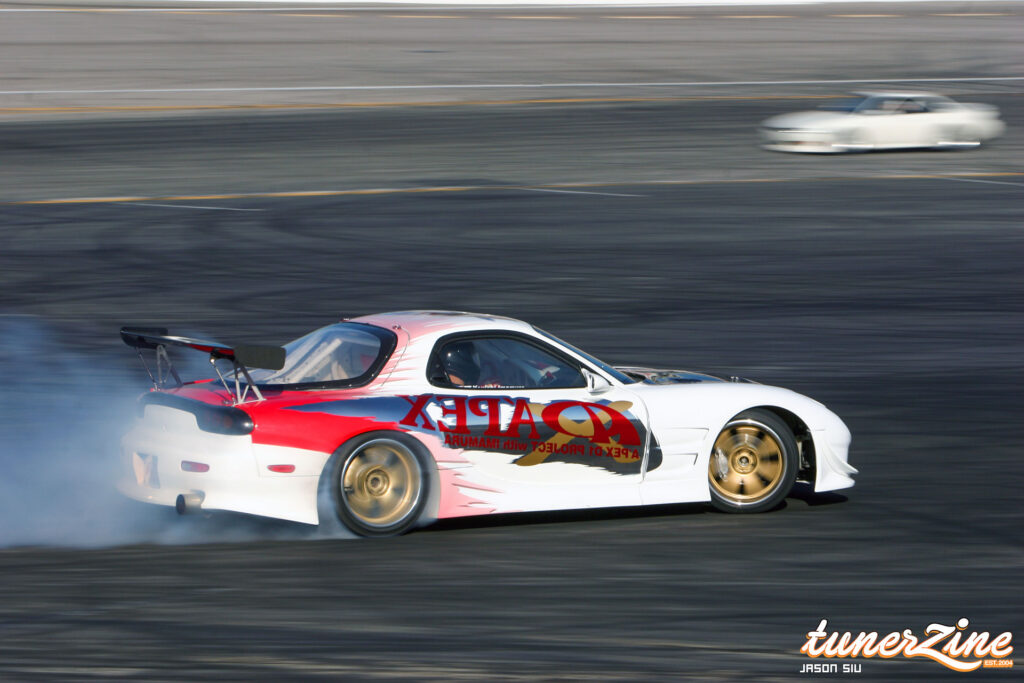
I was like, ‘wow, this is how pro teams do it.’ They rent the actual competition track and test ahead of the competition. So, I got a day of testing the bank ahead of time and unforgettable ride-alongs with Imamura and Takahiro Ueno in his Vertex Toyota Soarer,” he recalled.
The inaugural D1 Grand Prix USA exhibition event was held on August 31, 2003. According to Wan, it was the first recognized professional drift competition in the U.S., which took place on Irwindale Speedway’s full bank layout.
The field was stacked with new talent.
D1’s judge panel: Keiichi Tsuchiya, Manabu “Max” Orido, and Manabu Suzuki had selected America’s top eight—drivers who would soon become icons in their own right. Wan highlighted Ken Gushi, just 16 at the time, and future Formula D champion, Dai Yoshihara both came from pure grassroots drifting background, both of which are still actively drifting today.
Drift builds were much different then. Wan recalled his RX-7’s “simple steering setup, it was all stock knuckles with spacers on tie rods that extend the steering rack to give a little more angle based on the stock steering geometry. People were limited in angle because of those mechanical limitations—and power was low.”
His FD3S retained its stock ’99 spec twin-turbos and produced 356 horsepower with A’PEXi tuning. That was enough to drift the bank, albeit on a lower line. Even on that lower line, Wan recalled being one of the few U.S. drivers able to drift the big bank—a small victory as he prepared to face the Japanese field.
He laughed and said, “I can hang with the Japanese guys… kind of.”
Pushing his FD’s capabilities during D1 practice, he spun in the infield and backed into the inner wall, bending suspension components. Wan and his friends were learning fast.
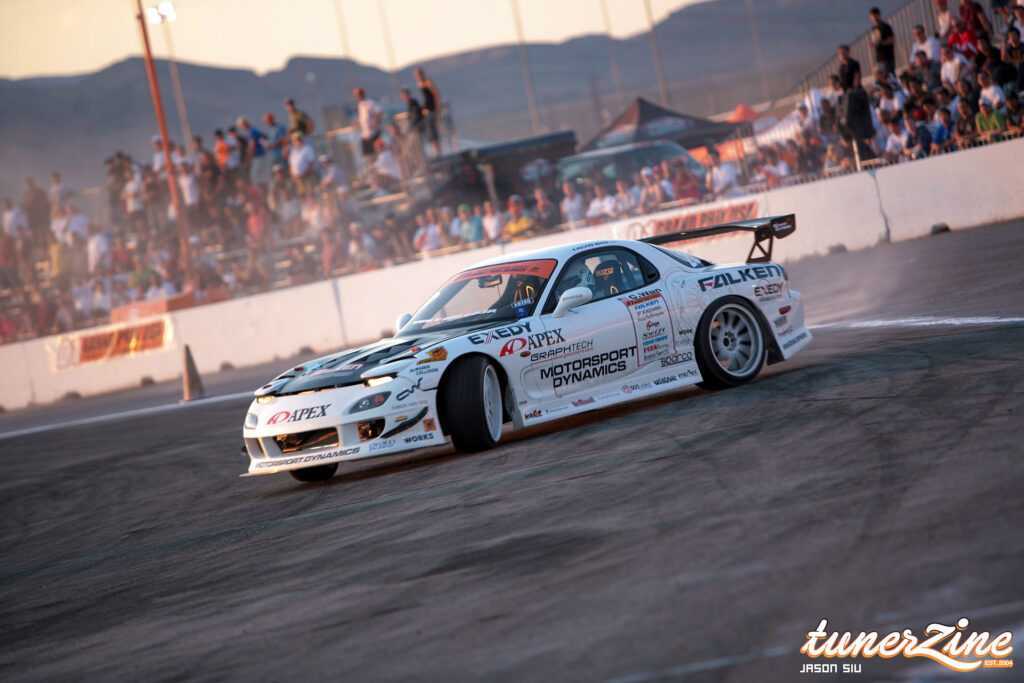
“We scrambled. I didn’t have a crew, only some friends that came and helped me out. We put the car together as quickly as we could. Unknowingly, the baffling broke in my fuel tank. We eyeballed the alignment and got things back together just in time to make it out for qualifying.” he said.
Wan laughed at the smaller details—like forgetting to put fuel in the tank.
“I went out and started driving. FDs are known for fuel starvation under half a tank. I started having fuel starvation at the main bank—when I initiated, the power kept cutting out.
Back then, you get three back-to-back runs, and no going back to the staging area. Each run, I ran lower on gas, and the car had less and less power on the bank. By the third run, I barely had enough power to drift the bank—I was super off-line and came really low; I had a bad line coming into the infield, spun, hit the wall hard, and totaled the car in front of everybody during competition.”
Wan recounted the experience with excitement and humility: “It was an honor just to be there. Although, I did gain some notoriety from that crash—I made it on the cover of a JDM Video Option (direct-to-video), titled Crash Kings!”
Formula D / D1GP
This all led to Formula Drift’s inaugural season which took place the following year in 2004. Wan explained its founders Jim Liaw and Ryan Sage, then at Slipstream Global, had helped bring D1 Grand Prix to the United States in 2003.
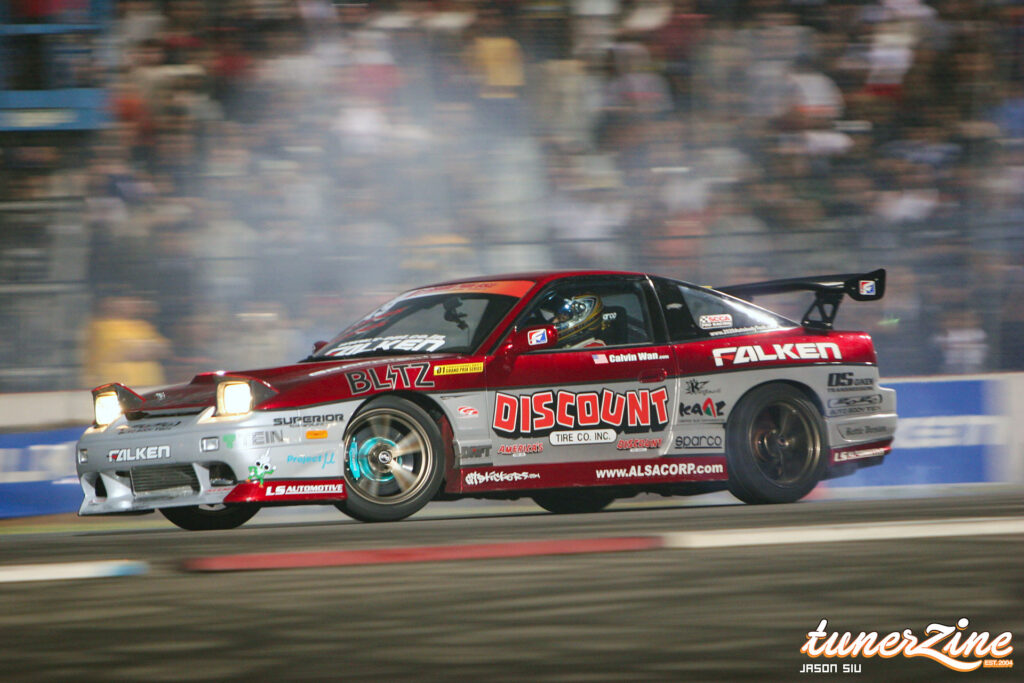
In 2004, Wan competed in a Nissan S13 hatchback. “It was co-title-sponsored by Falken and Discount Tire with a burgundy-and-silver livery,” he explained. He drove the S13 to a fourth place in the newly established Formula D series championship, while also competing in that year’s D1 Grand Prix.
Then, there was Samuel Hübinette and Rhys Millen, whose accomplishments extended to records in time attack and hill climb racing. “Those guys came from professional driving and the stunt driving world. They had high-level driving skills outside of drifting. Their factory backed professional race car shops allowed them to dominate in American drift cars the first three years of Formula Drift.
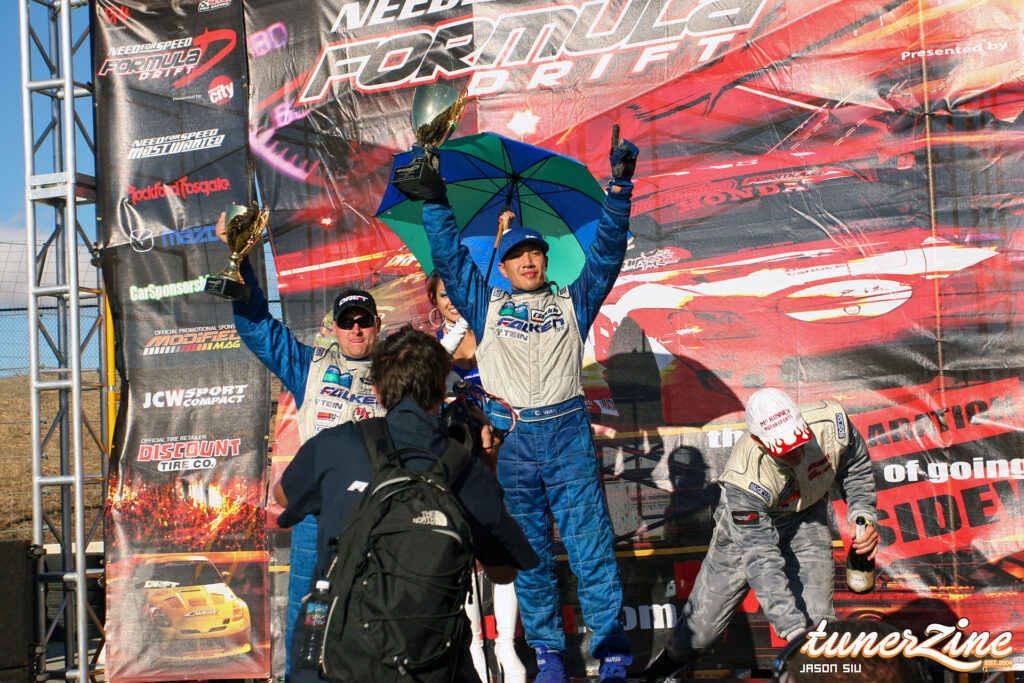
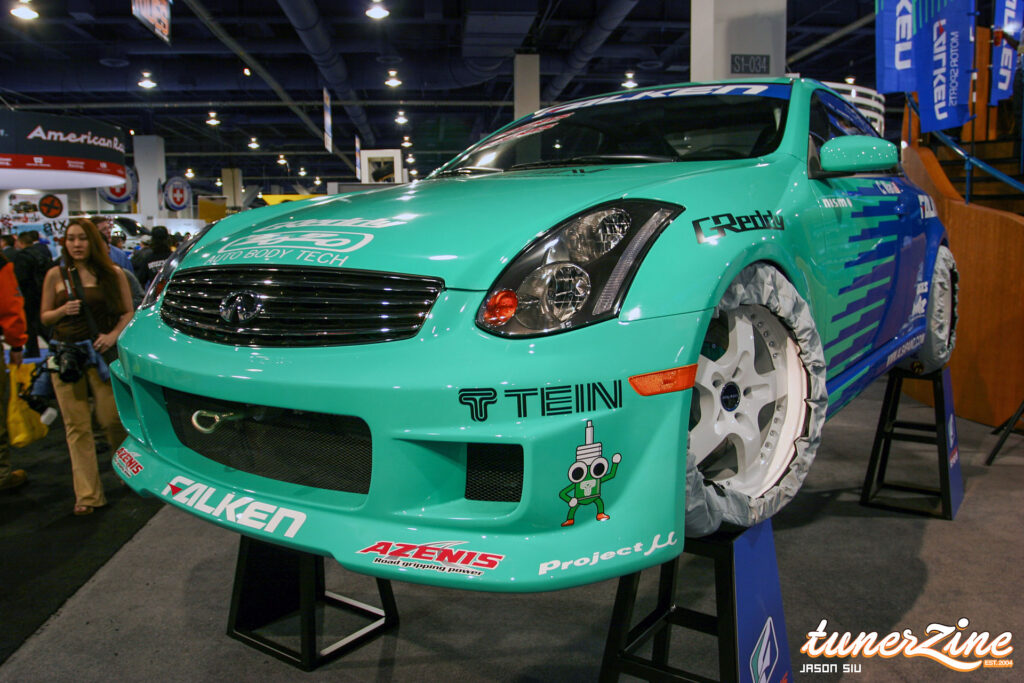
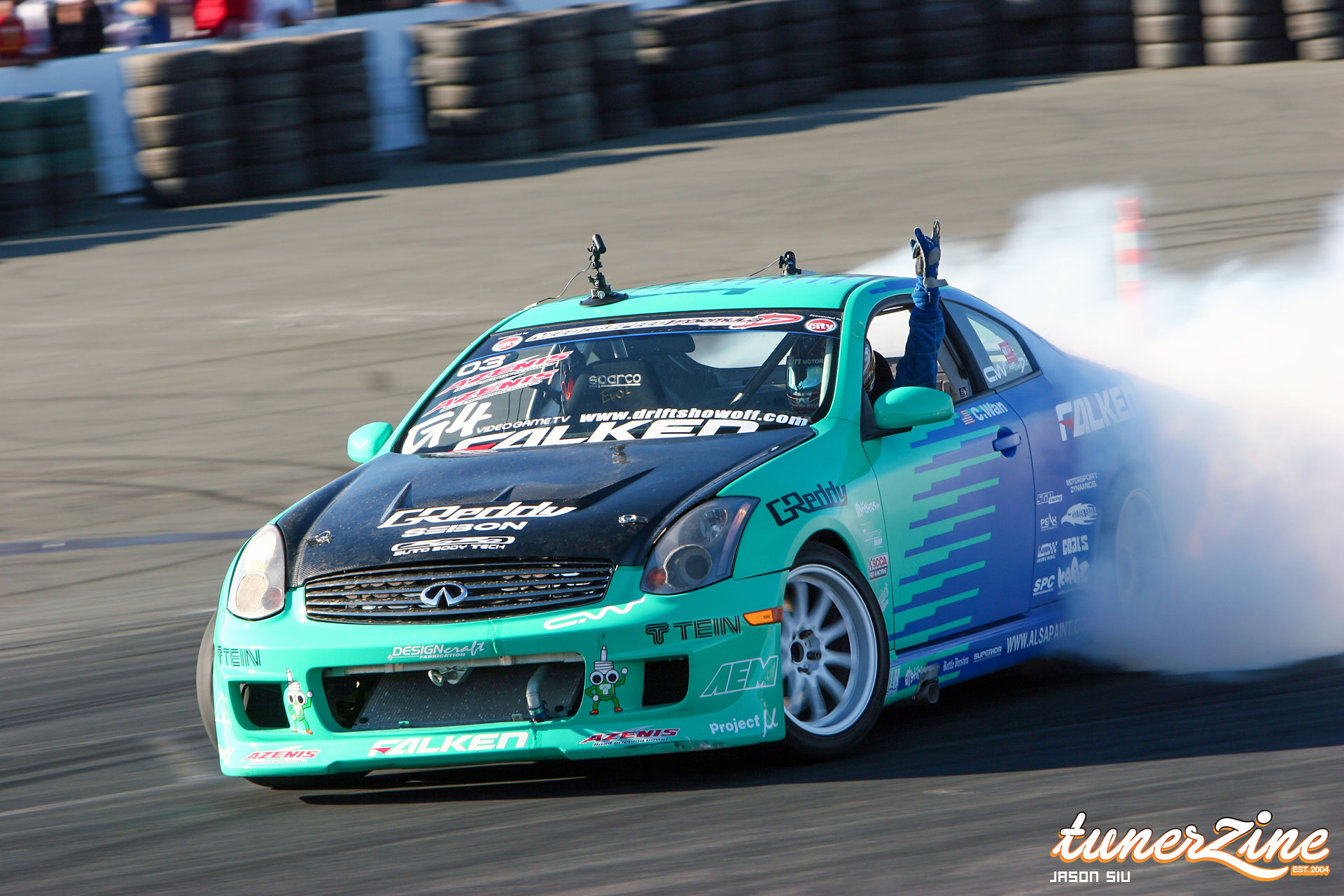
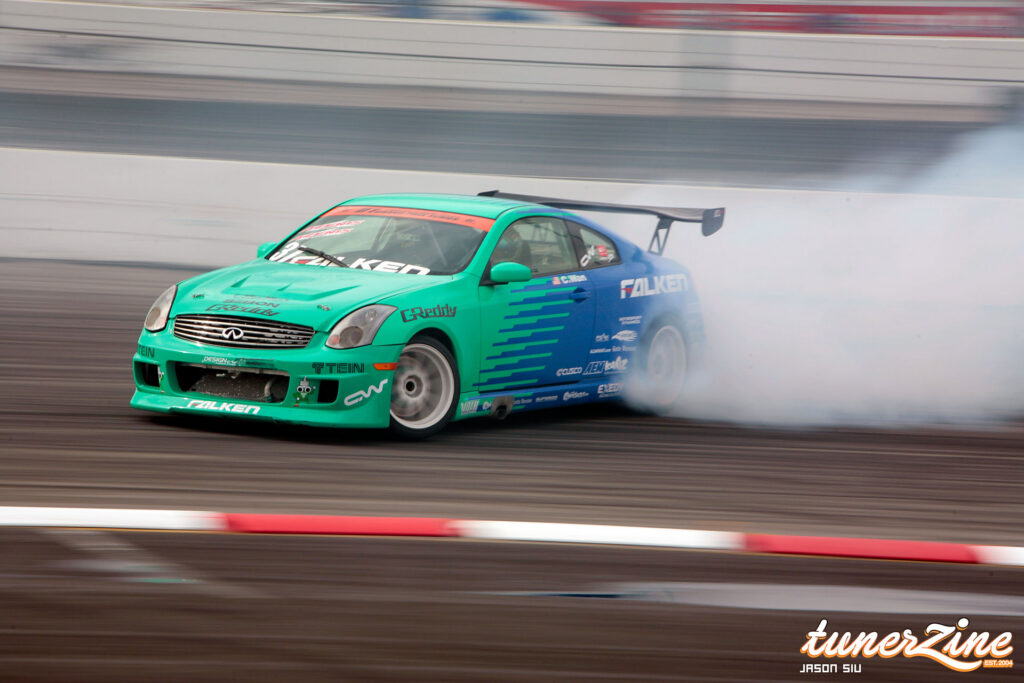
“My biggest accomplishment in drifting was becoming the first driver in the history of Formula Drift to win an event in an import car, which was in the Falken Tires Infiniti G35 at Round 4, Sonoma Raceway in 2005,” Wan said.
He mentioned other notable events like GT Live, held at the end of 2004. The event was U.S.-versus-Japan D1 and JGTC racing at California Speedway in Fontana, California. He described it as, “one the highlights in the early years.”
“Seeing actual JGTC cars racing in Fontana, along with pro D1 cars all shipped from Japan for one event— that was probably one of the greatest events in our industry, ever.”
International Spotlight
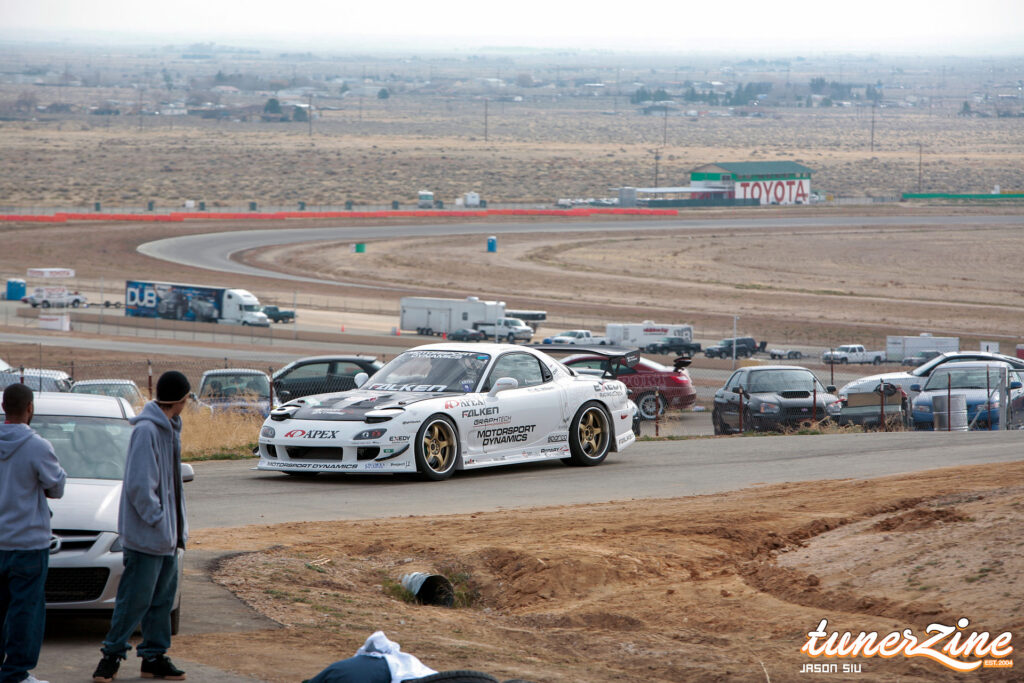
On December 17, 2006, Wan drove the Falken Mazda RX-7, while Vaughn Gittin Jr. drove the Falken Mustang. Both sported Falken’s famous “Teal and Blue” livery and competed at D1 Grand Prix’s World All-Stars event at Irwindale Speedway.
Wan said “D1’s first ever international event opened U.S. drivers’ eyes to drifting’s global reach.”
“When that [D1GP World All-Stars] event happened, Darren McNamara did well with his turbo-powered SR, AE86—he had a strong setup,” Wan recalled. “He shocked us, ‘whoa, there are some strong guys out of Ireland, the UK, and New Zealand too!’
We didn’t even know they had a drift scene until we saw them. I think there was even a Malaysian driver who came with an AE86 who did well—drivers from all over the world, it was really cool to see.”
The event’s success and worldwide coverage brought drifting to the main stage. For drivers who had started in a small, tight-knit community, seeing their cars and runs in international coverage was exciting.
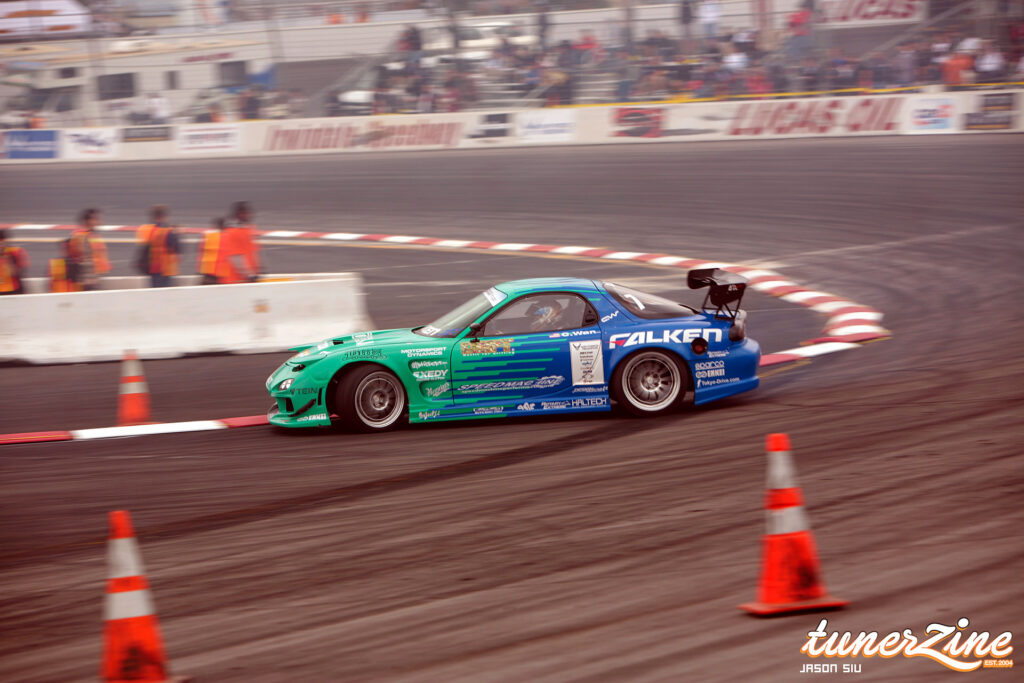
“It got a lot of print-media and international coverage. A lot of websites were doing event coverage—Tunerzine was a part of that as well! There were numerous photos to check out after the event. It was an exciting time,” he said.
LS, The New SR
Comparing today’s professionally-built drift cars to those of the early years is like comparing apples to oranges. Advances in technology have made these cars increasingly refined, driving the sport toward greater standardization.
Before modern angle kits, there were cut knuckles. Before external reservoirs and bypass valves, there were monotube struts with carefully chosen spring rates. Before 1,000-horsepower V8s, 450 horsepower was impressive.
Wan recalled an era when simple, reliable, and attainable builds defined competitive drifting.
“The standard drift build was an S-Chassis with a SR20DET. That was the benchmark drift car,” Wan said. “The AE86 was the N/A standard. People would tune their 4AGs and they had their power-to-weight advantages with a lightweight car that could still utilize that lower-power motor. They were so high strung that they were very competitive early on!”
Wan described the benchmark: “The SR was the LS motor. At the time, it was a stock engine with an upgraded turbo. Everyone wanted an SR because it was a proven engine that could make 350 to 400 horsepower and could be swapped into other chassis. It was probably low-to-mid 300s, but that was competition level in 2003 to 2004.”
“Katsuhiro Ueo proved to everybody that you could win those early D1 events in an N/A 4AG powered AE86!” Wan explained.
In the early 2000s, varied builds inspired distinct approaches behind the wheel. Naturally aspirated “Hachis” demanded aggression, their clutches taking relentless abuse to maintain momentum. Moderately powered S-chassis cars floated across tracks, initiating with huge feints before settling into line. Crowds could hear the burly rasp of an SR as the throttle hit the floor. F-chassis cars with turbo 13Bs were pinned at redline to maintain their drifts and expelled fire during brief moments off throttle. Big-body JZXs barreled down straights before a sharp feint shifted their weight, their 1JZ or 2JZ engines screaming as they hauled that mass through the turn.
Style was technique, and technique came from necessity.
“The focus was keeping the car drifting, holding as much speed as possible, and outrunning the chase car. The tandems weren’t as close,” Wan said.
Stiffer suspension and high tire pressures helped lower-powered cars drift at speed, Wan explained. “In competition, they had radar guns at different sections of the track, and that was a big part of the judging criteria. It got drivers to prioritize speed, which sacrificed angle,” he said.
Driving lines differed, too. Early drifters emulated the speed and smooth steering control of Japanese drifters like NOB Taniguchi. Wan recalled D1 videos displaying entry speeds and “drift clipping points were more focused on inner clips, mirroring a road racing line. There were less outer clips,” he said.
Low power, high speed, technique, and inner clipping points created a distinct style. But as competitive standards evolved, the builds that defined that era began to fall behind.
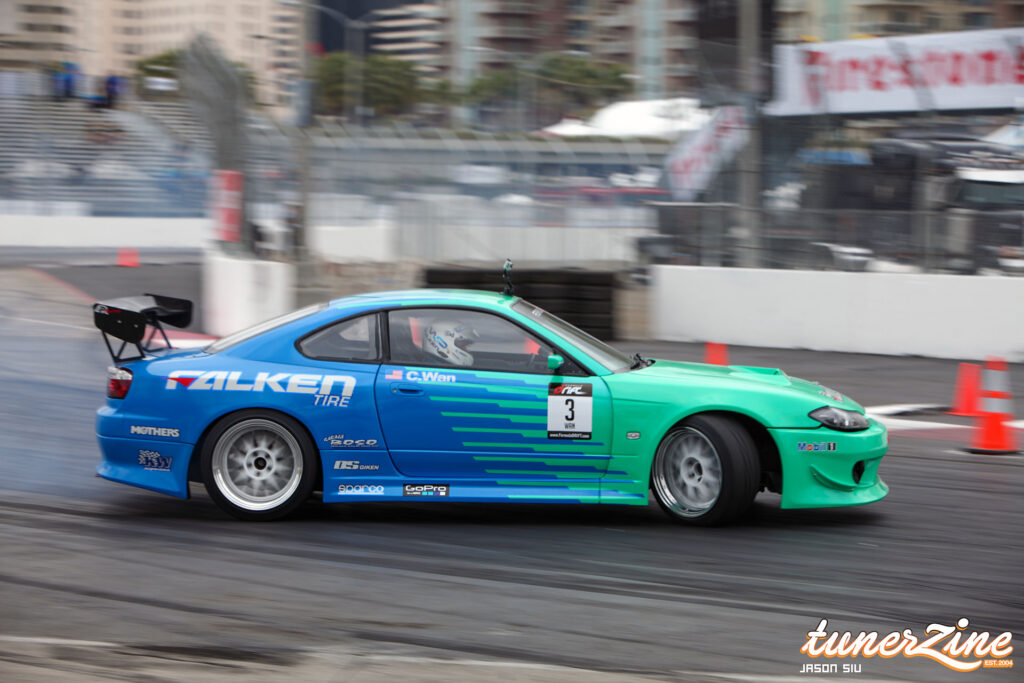
Calvin’s final year competing in Formula D was 2009. “I was in the Falken Tire S15, it was formerly the original HKS RS-1 S15— Nobuteru “NOB” Taniguchi finished 2nd place with it in the 2002 D1GP Championship.”
Dai Yoshihara had also driven this S15 in Formula D in 2007, with the Pacific Rim/Rockstar Energy livery.
Falken’s S15 race shop, Garage Boso/Racetune, had swapped in a fully built HKS 2.2 Stroker SR motor with its full turbine setup, the ultimate build—making over 500 horsepower. Unfortunately, that level of build was becoming inadequate. The SR competition era was near its end.
By the late 2000s, LS V8s were in vogue and swapped into everything. Falken Motorsports’ crew chief Ian Stewart of ASD turned it up another notch by using 800-horsepower naturally-aspirated V8 engines proven in sprint car racing. The formula made sense: power, reliability, and readily available racing-grade parts.
Wan recalled Daigo Saito circa 2012, “with his 1,200+ horsepower 2J build—at this time, the 2J was the only motor from the Japanese side that could compete. It was V8s and 2Js after that.”
The cold war of Japanese versus American power had begun.
Winning with a naturally aspirated 4AG-powered AE86 is nearly impossible in today’s field. The standardization of competitive power has reshaped driving techniques.
Wan described today’s approach as “a completely different mentality from before,” explaining that “back then, it was speed with low angle. Now it’s speed with high angle—which is really hard to do, the engineering behind drift cars nowadays is way different.”
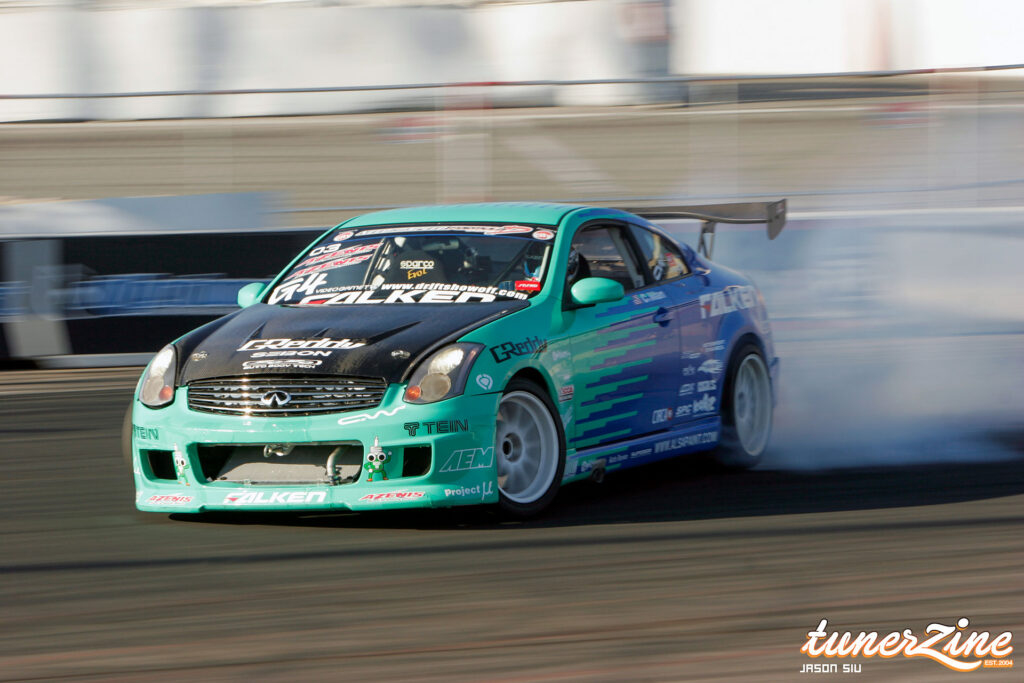
That shift was indicative of an arms race between horsepower and technology. It’s the natural progression of drifting and its judging criteria.
While it’s easy to adore the early era, drifting has grown far more intense. The combination of aggression and grace has become more astounding. High power with soft suspension and maximum grip results in high speeds, big angle, and massive plumes of smoke—a recipe that has amplified spectatorship.
Though some argue it excessive, today’s drivers remain inspired by Wan’s era.
Nostalgic Build
By 2010, Wan had his first child, and drifting became less of a priority. He stepped away to focus on his family. He and his wife would have three children, whose sports took precedence—including their oldest son’s kart racing.
“I got my oldest son, Case Wan, into go-kart racing. I became his driving coach and mechanic, wrenching on his kart and figuring out the karting motorsport which was new to me. He started with the K1 Speed Junior League and won the 2022 San Francisco championship, by one point!” Wan exclaimed.
Case moved into TAG cadet 2 stroke 60cc karts for the next three years and finished second overall in the 2023 ROK Sonoma Championship and third in the 2025 All-Star Karting Series. His son, now 14, is running full-size karts, and Calvin hopes to transition him into Spec Miata racing soon.
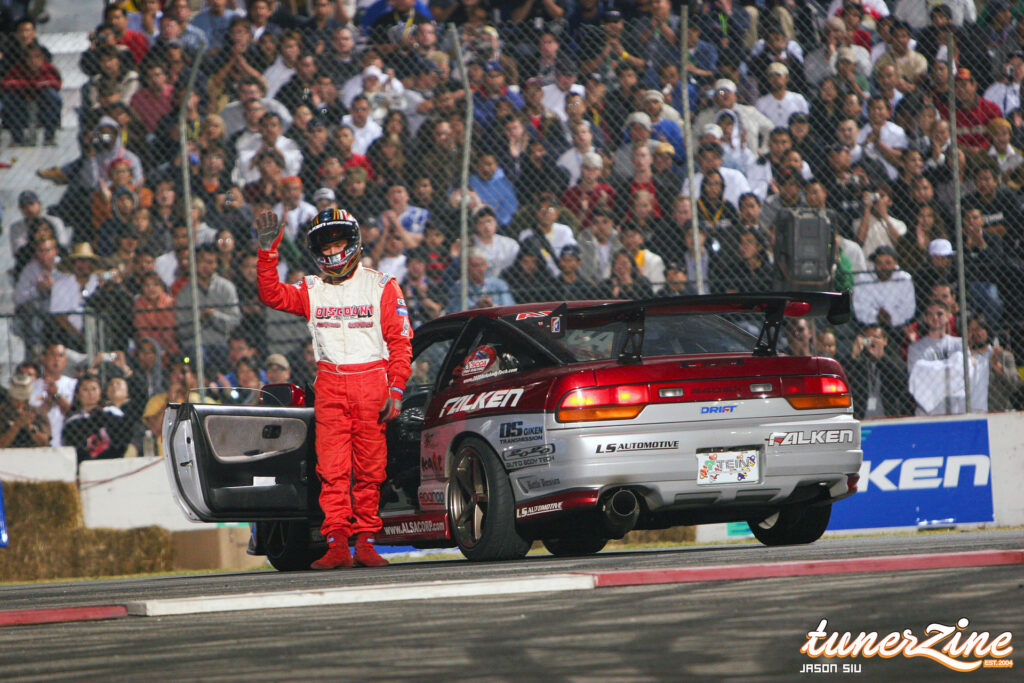
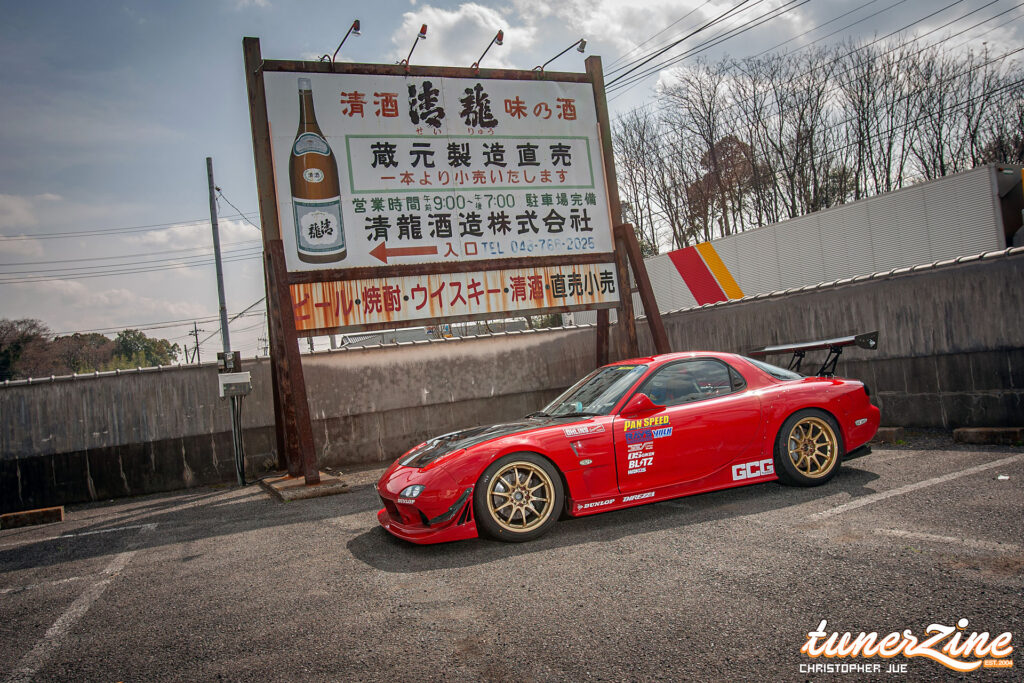
Wan follows modern drifting and enlisted one of his earliest sponsors, Ben Meeker of Rotary Extreme, to restore his personal Falken / CW Mazda FD3S as a period-correct nod to his original 2004 spec setup that Henry Chung of Motorsport Dynamics originally built. He wants to preserve the simplicity and style of early 2000s drift cars, with more of an emphasis on driving technique. Wan plans on joining drifting exhibitions at various lifestyle events to show younger generations where U.S. drifting began.
Japanese drifting has inspired generations for more than 30 years. Young enthusiasts watched Video Option tapes at a friend’s house and would study drifting style from their heroes. Who knew they would be chosen to challenge those icons? Be sure to thank Calvin Wan if you catch him in the wild—he and a handful of others are responsible for your drifting addiction.
GalleryPhotos by Jason Siu